Native Plants

Q. Who is Mr. Smarty Plants?
A: There are those who suspect Wildflower Center volunteers are the culpable and capable culprits. Yet, others think staff members play some, albeit small, role. You can torture us with your plant questions, but we will never reveal the Green Guru's secret identity.

Did you know you can access the Native Plant Information Network with your web-enabled smartphone?

Ask Mr. Smarty Plants
Ask Mr. Smarty Plants is a free service provided by the staff and volunteers at the Lady Bird Johnson Wildflower Center.

rate this answer

Friday - April 06, 2012
From: San Antonio, TX
Region: Southwest
Topic: Plant Identification
Title: Dodder
Answered by: Anne Ruggles & Nan Hampton
QUESTION:
I have seen patches of Bluebonnets that are covered with a stringy,rubbery,orange substance that seems to be choking out the particular patch. It wraps itself around the flowers,completely covering them and killing them. I am sure it is some kind of weed, but I have never seen it before. It spreads very quickly. I am wondering what it is, and if it has capabilities to do damage to large amounts of bluebonnets.ANSWER:
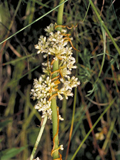
We have had another observant reader ask this question, too. You are seeing a species of Dodder, a very unusual and interesting native plant. There are more than 20 species species found in Texas many of which are described on the Wildflower Center's Native Plant Database. There are more than 150 species worldwide, although Dodder is most prevalent in the Americas.
We checked with two botanists (Laura Hansen and Bill Carr) who have experience with Dodder and both said they would not venture an identification as this is a difficult plant to identify to species and requires a dissecting scope. One of the botanists (Carr) did, however, offer this which is fun to say aloud.
No one seems to give a hoot a
'Bout the species of Cuscuta
Maybe they all think it's fine
To simply call it bailing twine.
As a species, we humans have been very creative in naming it. We have also called it: love vine, strangleweed, devil's-guts, goldthread, pull-down, devil's-ringlet, hellbine, hairweed, devil's-hair, and hailweed.
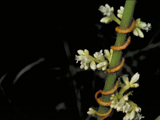
Dodder (in the genus Cuscuta), is an annual, twining yellow or orange parasitic plant that is classified in its own family, the Dodder Family (Cuscutaceae). Its water, minerals and carbohydrates are absorbed from the host through haustoria (modified adventitious roots) that penetrate the host's tissue.
It produces many tiny whitish flowers from early June to the end of the growing season. The tiny seeds are yellow to brown or black and are about 1/8” in diameter. The seeds drop to the ground and germinate the next growing season if a suitable host is present. If no suitable host is present, the seed may remain dormant for up to 60 years depending on the species and environmental conditions. Moist soil and sunlight are required for germination. Dodder seedlings must attach to a suitable host within a few days of germinating. The stem gropes in the air until it makes contact with a plant at which point the seedling coils around the plant a couple of times. If this plant is a suitable host, the dodder will sprout haustoria which will penetrate the stem. The basal part of the seedling shrivels away so that no soil connection exists. Dodder species vary in the number of host species they can infect. Some are rather restricted in both habitat and host preference and other species are quite cosmopolitan.
Other good sources of information about this interesting plant are:
1. There is a very good piece about Dodder on the Nature Writers of Texas blog by Ro Wauer from July 2006; "Dodder Looks Like Tangled Yellow-Orange Twine."
2. The University of California at Davis has a very descriptive web page, with photos, devoted to Dodder.
3. Mr. Smarty Plants discussed non-native Dodders a couple of years ago.
4. The USDA Natural Resources Conservation Service has photos and distribution maps of Dodder across the United States.
Dodder appears to be prevalent this year, perhaps because of the good rain parts of Texas are finally getting. It is a parasite and yes it will damage the host plant, but there are so many bluebonnets this year that it is not likely to have a population effect on them.
From the Image Gallery
More Plant Identification Questions
Identification of a shrub in San Marcos, TX
May 20, 2013 - On a walk in Austin's Barton Creek greenbelt, a Treefolks volunteer identified a shrub that I also have on my property in San Marcos as blue candalia. However I can't find a plant by that name via w...
view the full question and answer
How to have Mimosa and Yucca identified.
July 30, 2008 - Hello,
I have recently come across what I believe to be Mimosa microphylla in a very southwest corner of Mississippi. The only thing different about this patch is its brilliant white blooms! I can no...
view the full question and answer
Identification of plant responsible for thorns in dogs' fur
October 02, 2009 - Do you know of a plant or bush that has very small, very thin triangle shaped thorn? My dogs have been coming in with these in their fur and I want to get rid of the plant/bush they are coming from.
view the full question and answer
Plant identification of purple flower in Washington state
July 19, 2013 - I need help. I am a 10 year old girl who just happens to have a brother. He has a deep purple flower with small, oval shaped petals. We would like to know what it is. We planted it in a garden thing a...
view the full question and answer
State flower of Hawaii
January 04, 2006 - What color is the state flower of Hawaii?
view the full question and answer
| Support the Wildflower Center by Donating Online or Becoming a Member today. |