Native Plants

Q. Who is Mr. Smarty Plants?
A: There are those who suspect Wildflower Center volunteers are the culpable and capable culprits. Yet, others think staff members play some, albeit small, role. You can torture us with your plant questions, but we will never reveal the Green Guru's secret identity.

Did you know you can access the Native Plant Information Network with your web-enabled smartphone?

Ask Mr. Smarty Plants
Ask Mr. Smarty Plants is a free service provided by the staff and volunteers at the Lady Bird Johnson Wildflower Center.

rate this answer

Monday - March 20, 2006
From: Round Rock, TX
Region: Southwest
Topic: Invasive Plants
Title: Conversion of patch of bermuda grass to native perennial garden in Texas
Answered by: Nan Hampton and Joe Marcus
QUESTION:
My wife and I want to take a section of our front lawn that is currently in Bermuda grass and plant some native perennials with lots of flowers. The area will be a quarter-circle in a corner of the lawn with the 2 straight sides approximately 8-10 feet long. Three related questions, what would be the best way (ecological acceptable and good for the coming bed) to get rid of the Bermuda grass. What would be the best method of improving the soil, it is typical clay for Round Rock, Texas. Third what would be some good plant choices. The site gets sun until late-mid to late afternoon.ANSWER:
Bermuda grass is not easy to remove completely. Part of the problem is that it has multiple means of propagation—by seeds, rhizomes (underground lateral stems) and stolons (above ground lateral stems). There are essentially three choices of methods to remove your bermuda grass:
1. Dig up all the plants along with all their roots, rhizomes, and stolons. This is a daunting task for an entire lawn, but with the relatively small size of the area you want to convert to flower beds, it is not impossible. There are tools to helps you with this. You can use a sod-busting shovel or rent a sod-slicing machine. The problem lies in the fact that the rhizomes can be as deep as 6 inches and these tools may not be able to get below the rhizomes and their roots in an initial cut. You may have to dig out soil below that level. Even a small piece of rhizome left in the soil can root and form a new Bermuda grass plant. Any soil you remove in the process of removing the Bermuda grass sod could be replaced with an organic mix with the addition of course sand to alleviate the problems of your heavy clay soil.
2. "Solarize" the plot by covering it with plastic to kill the grass. This will take a minimum of 4 to 6 weeks and the problem is that solarization may not kill all the deep rhizomes and roots.
3. Apply herbicides. This is the least environmentally friendly method, but chemicals used judiciously can be very effective. It may, however, take as many as 3 or 4 treatments with an herbicide containing glyphosate (present in Roundup, Bronco, Landmaster, Ranger, Pondmaster, and Rattler) to completely kill the Bermuda grass. The Wildflower Center neither condones nor censures the use of herbicides; but, for your safety and for the preservation of the environment, we do strongly urge you to read and follow carefully the instructions in the use of such chemicals.
You may want to use a combination of the three methods above to remove your Bermuda grass. You can read articles from the University of California Integrated Pest Management Program and from the Arizona Daily Star describing in greater detail these methods to remove Bermuda grass.
When you have your soil free of Bermuda grass you can incorporate coarse builders sand and organic matter into the soil to improve your bed, although it may not be necessary if you use plants native to the Blackland Prairies. Also, you will want to add a pound-in edging around your new flower bed that extends at least 6 inches into the soil to prevent the Bermuda grass from encroaching on it.
Here's a starter list for Blackland Prairie perennials selected primarily from the Andy and Sally Wasowski's Native Texas Plants: Landscaping Region by Region, an excellent book that should be easy for you to find at your local library, bookstore, or garden center. The list here is limited to plants that prefer full sun, but you can find several options in the Wasowski's book for shady beds as well.
PERENNIALS, SUN
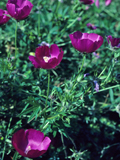
Perennial Winecups (Callirhoë involucrata)
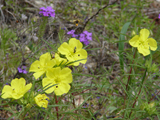
Sundrops (Calylophus berlandieri)
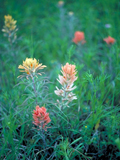
Purple paintbrush (Castilleja purpurea)
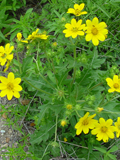
Cutleaf Daisy (Engelmannia peristenea)
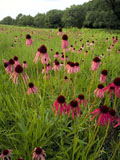
Purple coneflower (Echinacea purpurea)
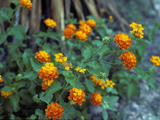
Lantana (Lantana urticoides)
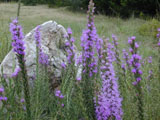
Gayfeather, Blazing Star (Liatris mucronata)
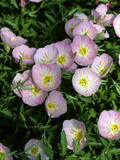
Pink Evening Primrose (Oenothera speciosa)
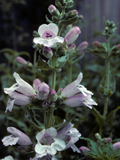
Foxglove Penstemon (Penstemon cobaea)
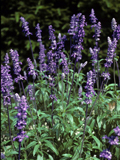
Mealy Blue Sage (Salvia farinacea)
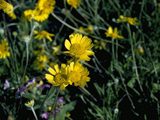
Four-Nerve Daisy (Tetraneuris scaposa)
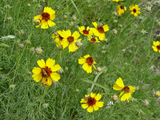
Greenthread (Thelesperma filifolium)
You can look for nurseries in your area that specialize in native plants and seeds in the National Suppliers Directory.
From the Image Gallery
More Invasive Plants Questions
Plant identification of tall stalk with many thorns
April 17, 2009 - Dear Mr. Smarty Pants:
After we raked all the leaves, I found three or four plants on my property that are thin tall stalks with many thorns. Leaves are just growing, so I cannot describe them. ...
view the full question and answer
Invasive non-native mulberry and groundcover in Jacksonville FL
October 02, 2011 - Northeast Florida (Jacksonville) inland. My mulberry tree provides dense shade in the summer and filtered light the other seasons, leaving sand in its growing area. What fast growing ground cover woul...
view the full question and answer
Eliminating bindweed in Eugene OR
June 04, 2010 - Any ideas on the best non-chemical way to get rid of bindweed in the Eugene, Oregon area? In addition to any other ideas you can suggest, are there any groundcovers that would do the job and be non-i...
view the full question and answer
What about Asian Jasmine and scrub oaks?
September 01, 2010 - Dear Mr. Smarty Plants,
I have several clusters of native scrub oaks in my yard. I planted Asian jasmine under them many years ago. The trees look fine, but an arborist has told me that the Asian ...
view the full question and answer
Possibility of camas being raised in Edmonton, Alberta
September 18, 2007 - I live in Edmonton, Alberta, and wish to find out how "Camassia (leichtlinii white) will fare in this zone.
view the full question and answer
| Support the Wildflower Center by Donating Online or Becoming a Member today. |