Native Plants

Q. Who is Mr. Smarty Plants?
A: There are those who suspect Wildflower Center volunteers are the culpable and capable culprits. Yet, others think staff members play some, albeit small, role. You can torture us with your plant questions, but we will never reveal the Green Guru's secret identity.

Did you know you can access the Native Plant Information Network with your web-enabled smartphone?

Ask Mr. Smarty Plants
Ask Mr. Smarty Plants is a free service provided by the staff and volunteers at the Lady Bird Johnson Wildflower Center.

rate this answer

Thursday - August 19, 2010
From: Dallas, TX
Region: Southwest
Topic: Vines
Title: Propagation of trumpet vines from Dallas
Answered by: Barbara Medford
QUESTION:
Can you tell me about trumpet vines, can they be rooted in water? I heard they reseed at the end of their growing season.ANSWER:
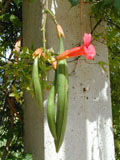
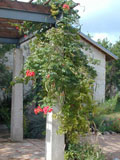
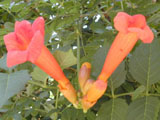
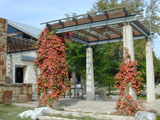
Campsis radicans (trumpet creeper) grows natively in the Dallas area, so they should do well where you are. We don't know if it can be rooted in water, but we do know it propagates itself to the point of madness. If you tried rooting it in water, it might take over your kitchen. Before you make any decisions about using this plant, we suggest you read this Dave's Garden Forum on Campsis radicans, especially the negative comments.
From our own Native Plant Database page on this plant, here are some more warnings:
"Native to eastern North America as far north as New York and Ontario, this vine is often cultivated for its attractive, reddish orange flowers and can escape cultivation, sometimes colonizing so densely it seems a nuisance, particularly in the southeast, where its invasive qualities have earned it the names Hellvine and Devils Shoestring. Its rapid colonization by suckers and layering makes it useful for erosion control, however, and its magnificent flowers never fail to attract Ruby-throated Hummingbirds within its range. Adapted to eastern forests, Trumpet creeper grows tall with support. It climbs by means of aerial rootlets, which, like English Ivy, can damage wood, stone, and brick. To keep it in check, plant it near concrete or an area that you can mow; mowing down the suckers will discourage them. Fairly drought tolerant within its range. Blooms most in full sun."
As an alternative, might we suggest Bignonia capreolata (crossvine)? It is more of an East Texas plant, but it grows in your area. The vines are related in that both belong to the Bignoniaceae Family, but while Crossvine also can grow rather vigorously, it is a little more controllable that the trumpet vine. Here are its propagation instructions:
"Propagation Material: Seeds , Softwood Cuttings , Root Cuttings
Seed Collection: Collect the large, woody capsules from late summer through fall when they are light brown and beginning to dry. Seeds remain viable one year in sealed, refrigerated containers.
Seed Treatment: Seed requires no pretreatment.
Commercially Avail: yes
Maintenance: Training to avoid crowding of stems will aid in the formation of flower shoots. Branches can be cut back in the spring to encourage flowering."
From our Native Plant Image Gallery:




More Vines Questions
Looking for a vine to grow on limestone pillars.
February 24, 2009 - Could you please suggest a vine which would grow on the limestone pillars at the front of our home near New Braunfels? We would like something that is attractive but does not harm our home. The pill...
view the full question and answer
Climbing vines for partial shade in North Texas
June 12, 2014 - I've read your recommendations for climbing vines in partial-shade, but requestor was from Central Texas (Austin-area). Would those recommendations hold true for North Texas (DFW area)?
view the full question and answer
Flowering Shade Plant for California
February 21, 2016 - I have a house north facing that has a "flower bed" in front that unfortunately is shaded 100% of the time. There are roses in the bed currently (they came with the house) but they do poorly. We are...
view the full question and answer
Groundcover for vineyard from Round Rock, TX
February 04, 2013 - I will be planting a vineyard in the Hill Country next spring. I am looking to maintain low-growing understory plants across the entire vineyard to maintain soil health, choosing plants that the leaf...
view the full question and answer
Identification of vine from Las Vegas NV
July 11, 2012 - I'm interested in identifying the vine shown by the leaf in this photo: https://picasaweb.google.com/lh/photo/zR3R4JSPYcCI4ESczNXWM4h8z33Cq5cyZNqSSYf9hx0?feat=directlink
My mother-in-law got one o...
view the full question and answer
| Support the Wildflower Center by Donating Online or Becoming a Member today. |