Native Plants

Q. Who is Mr. Smarty Plants?
A: There are those who suspect Wildflower Center volunteers are the culpable and capable culprits. Yet, others think staff members play some, albeit small, role. You can torture us with your plant questions, but we will never reveal the Green Guru's secret identity.

Did you know you can access the Native Plant Information Network with your web-enabled smartphone?

Ask Mr. Smarty Plants
Ask Mr. Smarty Plants is a free service provided by the staff and volunteers at the Lady Bird Johnson Wildflower Center.

rate this answer

Thursday - March 11, 2010
From: Austin, TX
Region: Southwest
Topic: Seed and Plant Sources
Title: Red bluebonnets in the garden
Answered by: Nan Hampton
QUESTION:
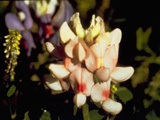
I bought 6 blue bonnet plants at Lowe's last fall. They survived the winter in my garden fine and they are now blooming (3/11)but they are red! Did I buy a wrong variety or is there something about my soil? I live in south Austin east of 35 where there is heavy clay soil, but these are planted in a bed of rich compost. I'll send along a picture with this. Thanks.ANSWER:
You didn't know it but you bought Aggie bluebonnets. If you are a UT Longhorn fan, you probably aren't going to be impressed with having Aggie bluebonnets in your garden. However, if you are a Texas A&M Aggie fan, you probably will be very happy. Dr. Jerry Parsons from Texas A&M developed these bluebonnets and has also come up with other colors of bluebonnets (there's also one called Barbara Bush Lavender). Actually, you may have the variety called "Henry's Red" or "Alamo Fire" and not the maroon Aggie bluebonnet. These red bluebonnets have been showing up more frequently (I saw them for sale at my local HEB Grocery last spring). Wildseed Farms in Fredricksburg has seeds of the Alamo Fire/Maroon bluebonnet for sale.
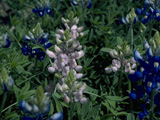
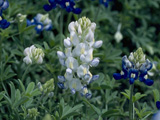
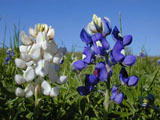
Just so that you know, if your red flowers are near enough to normal blue-colored bluebonnets so that at least some cross-pollination occurs, your next year's crop will not have all red flowers. It will probably be a mixture of blue, lavender and red. Red bluebonnets (or white, pink or lavender ones) are not true breeding. The form of the gene that produces the normal blue color is dominant over any of the other color variations so that any pollen from normal blue-colored bluebonnets that reaches your red flowers will ensure that next year's crop will not be all red. Only pollen from red bluebonnets fertilizing other red bluebonnets will give you red bluebonnets again next year.
More Seed and Plant Sources Questions
Source for Habiturf sod in Central Texas
October 02, 2015 - Do you know any source for Habiturf sod in Central Texas? I contacted Blade Runner Farms and they replied that their Habiturf project was discontinued.
view the full question and answer
Source for Dryopteris Filix-max Rhizomes in East Hanover NJ
June 15, 2009 - We are in search for 100kg Dryopteris Filix-mas (Male Fern) Rhizomes to extract oil
Kindly send your offer
view the full question and answer
Source for Bigelow oak in Austin
February 03, 2010 - Hi folks! I noticed on my last visit to the Wildflower Center that you now have a shrub white oak/Bigelow oak which I think is new (maybe I was just seeing it for the first time). I absolutely love ...
view the full question and answer
Wildflower Seed Collection Along Public Road in Blue Ridge, North Carolina
September 21, 2010 - I live in North Carolina and would like to plant native wildflowers on a steep bank in my yard. I live on a rural dirt road and most of the plants I want grow wild on the side of the road. Can I leg...
view the full question and answer
Smarty Plants on Hesperaloe parviflora
July 11, 2005 - I see these bright pink orange flowers on tall bracts everyday on the way to work. I have been searching for the name so I can buy one. I found a picture on your site at (http://www.wildflower.org/?...
view the full question and answer
| Support the Wildflower Center by Donating Online or Becoming a Member today. |