Native Plants
Q. Who is Mr. Smarty Plants?
A: There are those who suspect Wildflower Center volunteers are the culpable and capable culprits. Yet, others think staff members play some, albeit small, role. You can torture us with your plant questions, but we will never reveal the Green Guru's secret identity.
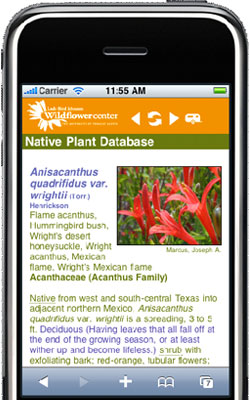
Did you know you can access the Native Plant Information Network with your web-enabled smartphone?

Ask Mr. Smarty Plants
Ask Mr. Smarty Plants is a free service provided by the staff and volunteers at the Lady Bird Johnson Wildflower Center.
rate this answer

Saturday - November 07, 2009
From: Adams Run, SC
Region: Southeast
Topic: Soils, Shrubs
Title: Foundation Plants for South Carolina
Answered by: Dean Garrett
QUESTION:
What native plants are suitable as foundation plantings? My soil is heavy clayey loam with red clay subsoil. I live in Charleston County.ANSWER:
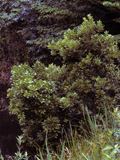
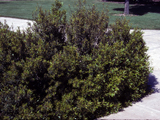
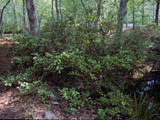
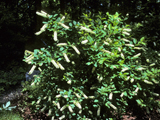
When people say foundation plants, they usually mean shrubs, and evergreen shrubs at that. Fortunately, there are a few plants native to your region of South Carolina that fit that description. Not knowing what size you have in mind, nor how much light and moisture your site receives, I can’t be sure my suggestions are right for you, but they are native to your county.
Yaupon Holly (Ilex vomitoria) comes in both standard and Dwarf Yaupon varieties, depending on your size needs, and is a standard landscaping shrub, easily trimmed into a hedge, if that’s what you prefer, and easy to care for.
Its relative, Inkberry (Ilex glabra), can reach 7 to 12 feet high and needs more moisture.
Another standard residential shrub is Wax Myrtle (Morella cerifera), also known as Southern Bayberry. It also comes in small and large varieties and is widely adaptable.
Harder to find and less common in residential landscapes are Coastal Leucothoe (Leucothoe axillaris) and Fetterbush (Lyonia lucida). Both are native to your area, prefer some shade, do well in moist well-drained soils, and are normally 2 to 6 feet tall. They are sensitive to overwatering and root disturbance, though, so should be left alone once established.
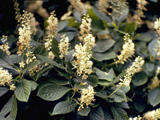
If you’re open to deciduous shrubs with showy blooms, you might consider Clethra (Clethra alnifolia) and Virginia Sweetspire (Itea virginica). Both normally range from 3 to 6 feet tall but can get substantially bigger. Clethra adapts well to clay soils.
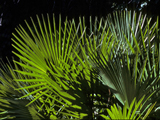
Another idea is the trunkless palm look of Dwarf Palmetto (Sabal minor), but spacing considerations will be important with it because its leaves can be stout and obtrusive. It is evergreen and ranges from circa 3 feet tall to as high as a man.
For more ideas, go to our Native Plant Database, scroll down to the Combination Search section, and select your state, site characteristics, and plant type preferences. A list of plants should come up for you to choose from, keeping in mind that not all will be good for your relatively coastal location.
I’ve relied on Sally and Andy Wasowski’s book, Gardening With Native Plants of the South, to answer your question. It has chapters on large and small shrubs for screening, flowers, and fruit.
Your state’s native plant society might also be of assistance.

More Soils Questions
What is composted mulch from Springfield IL
July 01, 2010 - I love the look of hard wood mulch. It is my understanding that this wood mulch that is so readily available in bulk and bags is not "composted mulch". I have been told that this type of mulch pull...
view the full question and answer
Recovering neglected garden space from Grapevine TX
March 22, 2014 - I live in Grapevine TX (Dallas). I just moved into a house where almost the entire large backyard is covered by oak trees that shed tons of leaves throughout our mild falls/winters. The yard has not...
view the full question and answer
Plants that will grow on the Connecticut coast
June 08, 2010 - I live on the coast in Connecticut and have a hard time growing plants here. I live about 1/2 mile from the beach and find that my soil is very rocky. The only plants that have done well in my yard ...
view the full question and answer
Possibility of growing oak-leaf hydrangea in Comal County, TX
January 08, 2005 - In the last issue of the magazine, there was an item about the oak leaf hydrangea which stated the plant's habitat is east of the Mississippi River.
Can it be grown in Comal County? Any special nee...
view the full question and answer
Using Horse Manure for the Garden
July 07, 2016 - Can you use horse manure for decomposed matter for your flower beds, etc.?
view the full question and answer
| Support the Wildflower Center by Donating Online or Becoming a Member today. |