Native Plants

Q. Who is Mr. Smarty Plants?
A: There are those who suspect Wildflower Center volunteers are the culpable and capable culprits. Yet, others think staff members play some, albeit small, role. You can torture us with your plant questions, but we will never reveal the Green Guru's secret identity.

Did you know you can access the Native Plant Information Network with your web-enabled smartphone?

Ask Mr. Smarty Plants
Ask Mr. Smarty Plants is a free service provided by the staff and volunteers at the Lady Bird Johnson Wildflower Center.

rate this answer

Monday - July 13, 2009
From: Houston, TX
Region: Southwest
Topic: Plant Identification
Title: Is this a sycamore tree in Houston TX?
Answered by: Barbara Medford
QUESTION:
I believe I have a 6 year old American Sycamore planted in front of my condo. There are no seed pods (balls) ever on this tree. I thought all Sycamores have those. Is my tree too young to produce the seed pods? My sister has one, only two years old..and she has the seed pods. I'm happy I DON'T have them (have heard they are very messy) yet..I just want to make certain this is an American Sycamore. Is it possible this tree will never have those seed pods?ANSWER:
Here's what we were able to find out about Platanus occidentalis (American sycamore). It is monoecious, meaning it has both male and female flowers on the same tree, so another tree of the same species does not have to be present in order to produce seeds. The fruit is a ball composed of many closely packed, long, narrow fruits that ripen by September or October and often remain on the tree over Winter, breaking up or falling off the tree the following Spring. A plantation or open-grown sycamore begins to bear seeds in 6 or 7 years. Natural stands of the tree begin to produce an appreciable number of seeds at about 25 years. The tree usually bears a good seed crop every one or two years, with optimum production between 50 and 200 years of age.
Possible conclusions:
1. Either the tree in your condo yard is not a sycamore or your sister's is not.
2. Your tree is a natural growth tree and will not begin to bear fruit and seeds until it is about 25 years old, while your sister's may be a plantation-grown tree. It would still have to be a little older than she thinks it is to be bearing fruit, however.
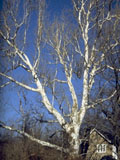
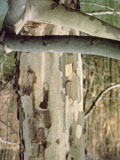
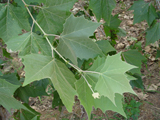
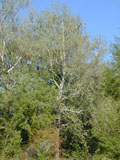
We are going to provide you pictures of the distinctive leaves and bark for comparison with both trees. If you do not believe your tree (or your sister's) is a sycamore, go to the Mr. Smarty Plants page on Plant Identification, and follow the instructions for sending us pictures and description, and we will try to identify it for you.
Pictures and more information from Virginia Tech VTree ID
Pictures and more information from North Carolina State University Fact Sheet
Pictures from Google Platanus occidentalis
From the Image Gallery
More Plant Identification Questions
Identification of wildflower in Illinois
April 03, 2008 - I have a similar question to the one asking about the blue/lilac wildflower in Illinois. Every year here in IL a blue, stragly, petal-ed flower/weed blooms - particularly along the edge of curbs alon...
view the full question and answer
Plant Identification from Ephrata PA
May 04, 2010 - I've come across a low plant with bright green leaves and a distinct burgundy on the leaf. I've been told it's called Throw Me Over The Fence, but I believe it must be called something else. I be...
view the full question and answer
Plant identification
February 20, 2014 - I'm not sure of county of origin. It was given to me by someone I no longer have contact with. When I initially received it I thought it was just a small potted vine of some type. I've had it a yea...
view the full question and answer
What is sage-like plant in New River AZ?
July 17, 2009 - I have a sage like looking plant growing wild in my yard. I live in the Sonora Desert. Its leaves are purple and once a year in spring it will bloom small blooms that are lavender. It grows 2 to 3 an...
view the full question and answer
Plant ID of succulent from Flagler Beach FL
July 08, 2012 - file:///C:/Users/CircuitCity/Downloads/All%20sizes%20%20%20baby%20plants%20growing%20on%20succulent%20leaves%20%20%20Flickr%20-%20Photo%20Sharing!_files/3901143728_dcf227ea85.jpg
I have a succulent t...
view the full question and answer
| Support the Wildflower Center by Donating Online or Becoming a Member today. |