Native Plants

Q. Who is Mr. Smarty Plants?
A: There are those who suspect Wildflower Center volunteers are the culpable and capable culprits. Yet, others think staff members play some, albeit small, role. You can torture us with your plant questions, but we will never reveal the Green Guru's secret identity.

Did you know you can access the Native Plant Information Network with your web-enabled smartphone?

Ask Mr. Smarty Plants
Ask Mr. Smarty Plants is a free service provided by the staff and volunteers at the Lady Bird Johnson Wildflower Center.

rate this answer

Sunday - January 25, 2009
From: O Fallon, MO
Region: Midwest
Topic: Grasses or Grass-like
Title: The effect of plant growth regulators (PGRs) on tall grass species
Answered by: Nan Hampton
QUESTION:
I have a question about some established native grass areas that we have on our golf course in eastern Missouri. For the past eight or nine years we have been working hard to transition these areas from the original tall fescue to a blend of Indian grass, Big bluestem, little bluestem and broomsedge. I would say that we have had a really nice transition, there are still some weeds but the native grasses are fairly established. The prairie areas are beautiful, 2008 was the first year we got more compliments than complaints about our native areas. Our current problem is that in some higher profile areas (areas close to houses mainly) our complaints have been about the mature height of these grasses. I am wondering if anyone has ever done any research on how these types of grasses may respond to a plant growth regulator? We use some pgr's on cool season turf such as bentgrass greens to slow their growth therefore allowing greens to roll more consistently and was wondering if some timely applications of a pgr would have any effect on height at maturity. This past spring we burned the natives in March and mowed them once in July with a sickle mower to about knee height. What would a pgr do to the plant if it was applied after either of these practices? Thank you Brent Rockwell Golf Course SuperintendentANSWER:
First of all, Mr. Smarty Plants salutes you for converting your golf course to native grasses!Unfortunately, I couldn't find any information on the use of plant growth regulators (PGR) on Sorghastrum nutans (Indiangrass) — 3 to 8 ft, Andropogon gerardii (big bluestem) — 4 to 8 ft, Schizachyrium scoparium (little bluestem) — 2 to 4 ft, or Andropogon virginicus (broomsedge bluestem) — 2 to 5 feet. Most of the research has been done on turf grasses (e.g., bentgrass and bermuda grass). I did, however, find one study on taller grasses, the cereal grasses:
Triticum aestivum (wheat) — 1.5 m (4.9 ft)
Avena sativa (oats) — 0.9m (3 ft)
Hordeum vulgare (barley) — 1m (3.3 ft)
A. Rajala and P. Peltonen-Sainio ["Plant Growth Regulator Effects on Spring Cereal Root and Shoot Growth", Agronomy Journal 93:946-943 (2001)] reported that the application of two plant growth regulators (PGR), chlormequat chloride (CCC) and trinexapac-ethyl, reduced the shoot length by as much as 20% and increased the number of tillers (shoots) per plant, but did not increase the total mass of the plants. They did not, however, use the PGRs in conjunction with mowing or burning. If you are interested, you might be able to find this journal with the article at a nearby univesrity (e.g., Washington University in St. Louis). With only the information from this article, I would think that application of GDRs to your taller species would likely reduce their height some, but I would guess not very much.
You might consider using other shorter grasses or sedges—or ones with more attractive foliage and/or seedheads, although I happen to think the ones you mentioned are attractive. Here are some suggestions for native grasses and seges found in eastern Missouri:
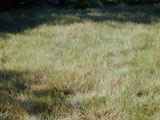
Bouteloua dactyloides (buffalograss) is a turf grass, but it would be ideal for sunny prairie areas since its maximum height is only 12 inches. The USDA Plants Database shows it occurring in a few counties in Missouri, one of which is St. Louis County just south of your county, St. Charles County.
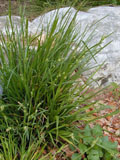
Carex blanda (eastern woodland sedge) is an evergreen sedge that grows in sun, part shade and shade, to less than 2 ft. You can see more information from Illinois Wildflowers.
Carex pensylvanica (Pennsylvania sedge) another low-growing sedge (<1.5 ft), with more information from Illinois Wildflowers.
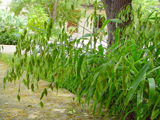
Chasmanthium latifolium (Inland sea oats) is a bunch grass that can grow as high as 4 ft, but it does this very happily in shade and part shade. It also has very attractive seed heads that are often used in flower arrangements.
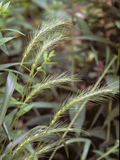
Elymus canadensis (Canada wildrye) is another 2 to 4 ft bunch grass with an attractive seed head often used in floral arrangements. It will do well in sun, part shade and shade.
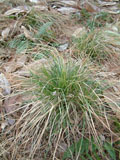
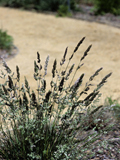
Koeleria macrantha (prairie Junegrass) is a low-growing clump grass (<1.5 ft) that is often used in prairie restoration projects. Here is more information from Illinois Wildflowers.
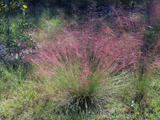
Muhlenbergia capillaris (hairawn muhly) is an attractive bunch grass that generally grows to less than 2 ft. Here is more information from Missouri Botanical Gardens.
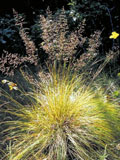
Sporobolus heterolepis (prairie dropseed) is another attractive bunch grass that generally grows to around 2 ft, with more information from Missouri Botanical Gardens.
More Grasses or Grass-like Questions
Need native plants to place in chicken coop in Charolette, NC
September 20, 2014 - Hi, I live near Charlotte, NC. I'm looking for native plants that I can plant in my chicken coop that will produce food for the chickens. If they also produced some delicious food for me, I wouldn't...
view the full question and answer
Drought tolerant plants for MA
August 28, 2011 - We have some very very poor soil at our house on Cape Cod and are looking for plants that will take low water and sandy soil. Also we are high on a hill and quite exposed to the elements. The plot get...
view the full question and answer
Need suggestions for plants for a 45 degree slope in Falls Church, VA.
January 23, 2013 - Have a 45 degree hillside 50 feet wide by 60 feet long on north side of 26 story building. Very little sun with the need for soil retention plants. Would like a native plant or plants to cover area...
view the full question and answer
Procedure for planting buffalograss
June 30, 2009 - I would like to get a full schedule of events/actions for planting a lawn with buffalo grass. The area is already a lawn, though mostly weeds. It is June/July. First, cover area to be seeded with b...
view the full question and answer
Planting Muhlenbergia capillaris (Gulf muhly)
October 27, 2011 - Is it too late to plant Gulf Muhly seed in North Texas (October)?
view the full question and answer
| Support the Wildflower Center by Donating Online or Becoming a Member today. |