Native Plants

Plant Database
Search for native plants by scientific name, common name or family. If you are not sure what you are looking for, try the Combination Search or our Recommended Species lists.
Fannon, Carolyn
Andropogon gerardii
Andropogon gerardii Vitman
Big Bluestem, Tall Bluestem, Turkeyfoot
Poaceae (Grass Family)
Synonym(s): Andropogon chrysocomus, Andropogon furcatus, Andropogon gerardii var. chrysocomus, Andropogon provincialis
USDA Symbol: ange
USDA Native Status: L48 (N), CAN (N)
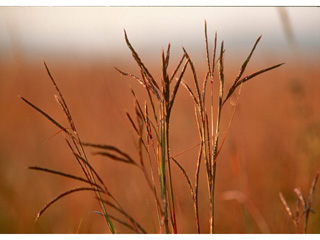
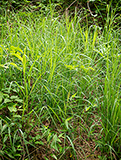
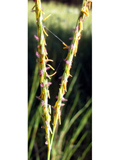
Big Bluestem is a warm season, perennial bunchgrass with blue-green stems 4-8 ft. tall. The seedhead is usually branched into three parts and resembles a turkey’s foot. Fall color is maroonish-tan.
Big Bluestem is the star component of the "Big Four" native grass species that characterize the tallgrass prairies of central North America (the other three are Indiangrass [Sorghastrum nutans], Switchgrass [Panicum virgatum], and Little Bluestem [Schizachyrium scoparium]). It tends to be taller than the other species and was at one time very abundant. It can still get quite aggressive when it's established in a favorable, undisturbed location, but overgrazing and land destruction have reduced it to mere patches of its former range. Part of the problem is that cattle love it so much - some ranchers refer to it as "ice cream for cows" - and it cannot take concentrated grazing; the seasonal grazing of migratory bison is what it's evolved to cope with.


Plant Characteristics
Duration: PerennialHabit: Grass/Grass-like
Root Type: Fibrous
Leaf Arrangement: Alternate
Leaf Complexity: Simple
Leaf Venation: Parallel
Inflorescence: Spikelet
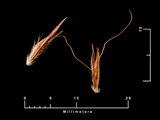
Fruit Type: Caryopsis
Size Notes: 4-8 feet tall.
Leaf: Green or blue-green. Russet in winter.
Autumn Foliage: yes
Bloom Information
Bloom Color: Red , Blue , BrownBloom Time: Aug , Sep , Oct , Nov
Distribution
USA: AL , AR , AZ , CO , CT , DC , DE , FL , GA , IA , IL , IN , KS , KY , LA , MA , MD , ME , MI , MN , MO , MS , MT , NC , ND , NE , NH , NJ , NM , NY , OH , OK , PA , RI , SC , SD , TN , TX , UT , VA , VT , WI , WV , WYCanada: MB , ON , QC , SK
Native Distribution: Que. & ME to Sask. & e. MT, southeast to FL, west to AZ and south through Mexico to Costa Rica
Native Habitat: Usually in low meadows and prairies, rare in extreme west. Most abundant in the central plains but also a prairie component in moist grasslands all the way to the east coast.
Growing Conditions
Water Use: Low , MediumLight Requirement: Sun , Part Shade
Soil Moisture: Moist
CaCO3 Tolerance: High
Drought Tolerance: High
Soil Description: Acid or calcareous sands, loams, and clays.
Conditions Comments: Big Bluestem needs more moisture to look its best than does Little Bluestem (Schizachyrium scoparium), but it is quite drought-tolerant when in deep prairie soils because of its deep roots. If used in a garden, too much water, shade, or fertilizer can cause it to get top-heavy and fall over. It is moderately tolerant of acidity and salinity and can withstand periodic flooding and high water tables.
Benefit
Use Ornamental: An essential grass for grassland restoration and prairie gardens in the central plains. Large stature, blue-green foliage, and interesting flowering heads.Use Wildlife: Provides cover for at least 24 species of songbirds and nesting sites or seeds for Grasshopper Sparrow, Henslow’s Sparrow, and other sparrows, as well as nesting sites for Sedge Wrens and Western Meadowlarks.
Conspicuous Flowers: yes
Interesting Foliage: yes
Attracts: Birds , Butterflies
Larval Host: Delaware Skipper, Dusted Skipper
Deer Resistant: High
Value to Beneficial Insects
Provides Nesting Materials/Structure for Native BeesThis information was provided by the Pollinator Program at The Xerces Society for Invertebrate Conservation.
Butterflies and Moths of North America (BAMONA)
|
Delaware Skipper (Anatrytone logan) 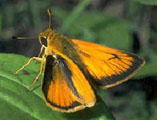 Larval Host |
Dusted Skipper (Atrytonopsis hianna) 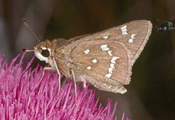 Larval Host |
Propagation
Propagation Material: Root Division , SeedsDescription: Seed or root division during winter dormancy
Seed Collection: October and November
Seed Treatment: Dry stratification as well as cold-moist stratification have been recommended.
Commercially Avail: yes
Maintenance: It may be cut back, mowed, or burned in late winter. Should not be mowed during the growing season, as that could kill it. However, in areas where it gets aggressive, like the central and northern tallgrass prairie, mowing can help limit its expansion.
Find Seed or Plants
Order seed of this species from Native American Seed and help support the Wildflower Center.
Find seed sources for this species at the Native Seed Network.
View propagation protocol from Native Plants Network.
Mr. Smarty Plants says
When to plant grasses on Long Island, NY
December 06, 2009
Dear Mr. Smarty Plants;
Are there any grass seeds that I can plant NOW, early December, on Long Island, NY? The planting environment is on and near a sandy bluff on a bayshore, where it can be windy ...
view the full question and answer
Plants to control hillside erosion in Vermont
May 23, 2008
Hi, I am trying to do an eagle project that involves putting vegetation onto a hill to prevent erosion. I live in Vermont. What kinds of plants would hold together a hillside and could be planted in ...
view the full question and answer
National Wetland Indicator Status
| Region: | AGCP | AK | AW | CB | EMP | GP | HI | MW | NCNE | WMVE |
| Status: | FAC | FACU | FAC | FACU | FAC | FACU | FACU |
From the National Organizations Directory
According to the species list provided by Affiliate Organizations, this plant is on display at the following locations:Lady Bird Johnson Wildflower Center - Austin, TX
Native Plant Center at Westchester Community College, The - Valhalla, NY
Nueces River Authority - Uvalde, TX
Texas Parks and Wildlife Department - Austin, TX
North American Native Plant Society - Etobicoke, ON
Natural Biodiversity - Johnstown, PA
Native Seed Network - Corvallis, OR
NPSOT - Williamson County Chapter - Georgetown, TX
Bibliography
Bibref 1186 - Field Guide to Moths of Eastern North America (2005) Covell, C.V., Jr.Bibref 1185 - Field Guide to Western Butterflies (Peterson Field Guides) (1999) Opler, P.A. and A.B. Wright
Bibref 946 - Gardening with Prairie Plants: How to Create Beautiful Native Landscapes (2002) Wasowski, Sally
Bibref 318 - Native Texas Plants: Landscaping Region by Region (2002) Wasowski, S. & A. Wasowski
Bibref 291 - Texas Wildscapes: Gardening for Wildlife (1999) Damude, N. & K.C. Bender
Bibref 1294 - The Midwestern Native Garden: Native Alternatives to Nonnative Flowers and Plants An Illustrated Guide (2011) Adelman, Charlotte and Schwartz, Bernard L.
Search More Titles in Bibliography
Research Literature
Reslit 258 - A soil heat and water transfer model to predict belowground grass rhizome bud death in a grass fire (2009) J. Choczynska and E. A. JohnsonReslit 232 - Relationship of seed source and arbuscular mycorrhizal fungi inoculum type to growth and colonization of big bluestem (Andropogon gerardii) (2006) N. Cavender and M. Knee
Reslit 179 - Relative Rooting Depths of Native Grasses and Amenity Grasses with Potential for Use on Roadsides in New England (2010) R. N. Brown, C. Percivalle, S. Narkiewicz and S. D...
Reslit 143 - Burning and grazing to promote persistence of warm-season grasses sown into a cool-season pasture (2010) E. L. Bouressa, J. E. Doll, R. L. Cates, Jr. and R...
Reslit 102 - Age of maturity and life span in herbaceous, polycarpic perennials (2000) M. H. Bender, J. M. Baskin and C. C. Baskin
Reslit 425 - Germination, survival, and growth of grass and forb seedlings: effects of soil moisture variability (2009) P. A. Fay and M. J. Schultz
Reslit 288 - Fire season and dominance in an Illinois tallgrass prairie restoration (2002) T. E. Copeland, W. Sluis and H. F. Howe
Reslit 543 - Competitive relationships of Andropogon gerardii (Big Bluestem) from remnant and restored native populations and select cultivated varieties (2004) D. J. Gustafson, D. J. Gibson and D. L. Nickrent
Reslit 544 - Conservation genetics of two co-dominant grass species in an endangered grassland ecosystem (2004) D. J. Gustafson, D. J. Gibson and D. L. Nickrent
Reslit 545 - Using local seeds in prairie restoration - data support the paradigm (2005) D. J. Gustafson, D. J. Gibson and D. L. Nickrent
This information was provided by the Florida WIldflower Foundation.
Search More Titles in Research Literature
From the Archive
Wildflower Newsletter 1985 VOL. 2, NO.4 - Message From Helen Hayes, Head for the Hill Country, Spring Tours at the Center,...Wildflower Newsletter 1986 VOL. 3, NO.3 - Fall Planting Tips, Growth Provides Enthusiasm, 1985 Financial Facts, Gathering ...
Wildflower Newsletter 1988 VOL. 5, NO.2 - Researching Wildflower Seed Quality, Wildflower Center Receives $500 -000 Gift, ...
Wildflower Newsletter 1998 VOL. 15, NO.4 - Grasses from the Ground Up, Celebrating Wildflowers Hotline, Executive Director\...
Additional resources
USDA: Find Andropogon gerardii in USDA PlantsFNA: Find Andropogon gerardii in the Flora of North America (if available)
Google: Search Google for Andropogon gerardii
Metadata
Record Modified: 2015-12-08Research By: TWC Staff, GDG