Native Plants
Q. Who is Mr. Smarty Plants?
A: There are those who suspect Wildflower Center volunteers are the culpable and capable culprits. Yet, others think staff members play some, albeit small, role. You can torture us with your plant questions, but we will never reveal the Green Guru's secret identity.
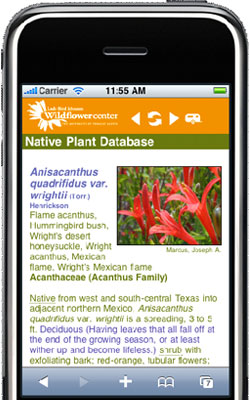
Did you know you can access the Native Plant Information Network with your web-enabled smartphone?

Ask Mr. Smarty Plants
Ask Mr. Smarty Plants is a free service provided by the staff and volunteers at the Lady Bird Johnson Wildflower Center.

rate this answer

Thursday - January 01, 2009
From: Abilene, TX
Region: Southwest
Topic: Grasses or Grass-like
Title: Grass for area under pecans in Abilene, TX
Answered by: Barbara Medford
QUESTION:
I have two large pecan trees in my back yard. Grass has always been hard to grow under these two trees, but lately all grass seems to have "vanished" and I'm left with mostly bare soil. Is there any kind of lawn that I can grow under these two trees?ANSWER:
Mr. Smarty Plants was recently asked a similar question, and rather than repeat the information, would like for you to read that previous answer.
All plants have some sort of defense mechanism to assure they get their own space and can have all the nutrients they want from the soil. Members of the Carya genus, which includes pecans, hickories and walnuts, emit chemicals called juglones, which can damage or kill plant material beneath the tree. Plants that chemically protect themselves are referred to as allelopathic. Usually they don't begin to show these tendencies until the plant in question has reached a certain level of maturity, and needs more nutrients and water from the soil. Although the pecan has a taproot, it still has roots 6 to 12 inches from the surface of the soil, probably extending far beyond the dripline of the tree. Combined with the shade of a mature pecan tree, the grass beneath your tree simply had to go, as far as the tree was concerned.
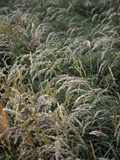
However, as you'll note from the previous answer we referred you to, there are grasses that can survive in shade and seem to be somewhat resistant to the tree's chemical warfare. You didn't say what grass you had under the tree originally, but we would urge the use of grasses native to your area. At the Lady Bird Johnson Wildflower Center, we support the use and propagation of plants native not only to North America but also to the area in which the plant is being grown. Most of the commonly used turf grasses, including Bermudagrass and St. Augustine, are non-native. A native plant will have a better chance of survival because it has already evolved to be tolerant of the soil, climate and moisture where it is being grown.
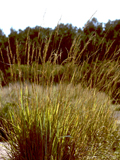
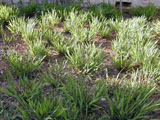
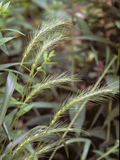
To find grasses that should work in your area, we went to our Recommended Species section, and clicked on "Texas High Plains" on the map. We then went to NARROW YOUR SEARCH and specified "grasses" under Habit, and part shade (2 to 6 hours of sun daily) under Light Requirements. This gave us a list of 7 grasses that are recommended as doing well in the Abilene area, from which we selected 4. We also checked out the 4 grass selections in the previous answer, and found they are also possibilities for your area, with some notes on their needs.
Follow the plant links to our website on each grass, and read what their expected heights are, whether they are cool-season or warm-season grasses and how to propagate them. None of these are what you would call a turf grass, but they are attractive, hold their places year round, and serve as nesting areas and food sources for birds. When you have made some choices, go to our Native Plant Suppliers section, type in your town and state in the "Enter Search Location" box and you will get lists of native plant nurseries, seed companies and landscape consultants in your general area. In particular, we would suggest Native American Seed in Junction, TX, which has an extensive grass selection in their online catalog with more information, and they provide mail order.
Bouteloua curtipendula (sideoats grama)
Pascopyrum smithii (western wheatgrass)
Poa arachnifera (Texas bluegrass)
Sorghastrum nutans (Indiangrass)
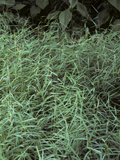
Chasmanthium latifolium (Inland sea oats) - tends to prefer more acidic soil than you are likely to have in the Abilene area, but seem to be pretty adaptable, worth a try
Elymus canadensis (Canada wildrye) - also prefers slightly acidic soils
Muhlenbergia schreberi (nimblewill) - needs moisture
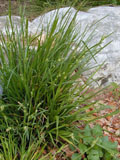
Carex blanda (eastern woodland sedge) - also needs moisture
More Grasses or Grass-like Questions
Grasses for a pasture in Hays County, Texas with horses
March 20, 2015 - I intend to sow grass seed over a few acres of pasture on which I'll have a couple of horses in Driftwood, TX. I'd like to know what variety of seed(s) would be most beneficial to the land - and th...
view the full question and answer
Deer resistant native plants for Eagle Scout project in Urbandale IA
April 27, 2013 - Mr. Smarty Plants, My son is planning his Eagle Scout Project doing some landscaping for the Iowa Primate Learning Sanctuary. The facility has asked him to use only plants native to Iowa. Can you su...
view the full question and answer
Native water plants for bio-retention pond in North Carolina
July 22, 2009 - I am looking for North Carolina native plants that can take part shade and very wet conditions (bioretention pond environment). Any suggestions?
view the full question and answer
Controlling erosion with grasses in Dallas, TX
October 19, 2013 - After consulting with several geological engineers and the city of Dallas engineers - we know that our severe erosion problem can only be fixed by building a 35' foot high gabion wall about 150' in ...
view the full question and answer
Native Grass Lawn For Georgia
January 20, 2015 - Grass in Atlanta when I was little (I am 50 years old and have lived in Atlanta most of my life) was of a fescue variety. Bermuda grasses were considered "rich person's grass" when I was young. M...
view the full question and answer
| Support the Wildflower Center by Donating Online or Becoming a Member today. |