Native Plants
Q. Who is Mr. Smarty Plants?
A: There are those who suspect Wildflower Center volunteers are the culpable and capable culprits. Yet, others think staff members play some, albeit small, role. You can torture us with your plant questions, but we will never reveal the Green Guru's secret identity.
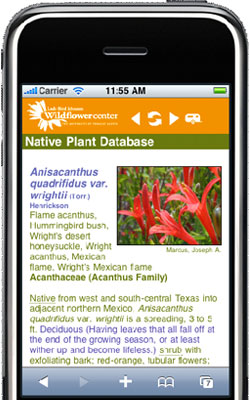
Did you know you can access the Native Plant Information Network with your web-enabled smartphone?

Ask Mr. Smarty Plants
Ask Mr. Smarty Plants is a free service provided by the staff and volunteers at the Lady Bird Johnson Wildflower Center.
rate this answer

Thursday - May 15, 2008
From: Clearfield, PA
Region: Mid-Atlantic
Topic: Edible Plants
Title: Edible fruits and plants in Pennsylvania
Answered by: Nan Hampton
QUESTION:
Can you give me a list of edible berries and plants that someone might find if they were hiking through the forest of Pennsylvania?ANSWER:
Mr. Smarty Plants doesn't even know ALL the edible native plants in Pennsylvania, but there are books that can give you a listing of the best ones. For instance, Edible Wild Plants of Pennsylvania and Neighboring States by F. J. Medve and others; Edible Wild Plants of Eastern North America by M. L. Fernald and others; and Field Guide to Edible Wild Plants: Eastern and Central North America by L. Peterson all are excellent references. These books provide you with means to identify the plants, habitat and distribution, which parts are edible, how to prepare the plant, poisonous plants to avoid, etc. Here, also, is a page of foraging and ethnobotany links from Foraging.com.Just to give you an idea of the great variety of edible native plants you can find, below is a partial list of trees and shrubs only that grow in Pennsylvania that bear edible fruit. There are many more herbaceous plants as well that are edible.
A cautionary note: Be sure you know what plant you're about to eat! There are look-alike plants that can give very unpleasant, even dangerous, results if eaten.
Carya alba (mockernut hickory)
Castanea dentata (American chestnut)
Cercis canadensis (eastern redbud) (edible flowers)
Celtis occidentalis (common hackberry)
Diospyros virginiana (common persimmon)
Prunus americana (American plum)
Prunus angustifolia (Chickasaw plum)
Prunus pensylvanica (pin cherry)
Prunus serotina (black cherry)
Prunus virginiana (chokecherry)
Corylus americana (American hazelnut)
Gaylussacia dumosa (dwarf huckleberry)
Mahonia repens (creeping barberry)
For the next 3 genera, use the "Narrow Your Search" option to limit the species to Pennsylvania.
Ribes spp. (currants and gooseberries)
Rubus spp. (blackberries, raspberries, dewberries)
Vaccinium spp. (cranberries, blueberries, huckleberries)
More Edible Plants Questions
Can bluebonnets be made into jelly from Ennis TX
May 07, 2013 - Are Texas bluebonnet flowers okay for human consumption? I have seen recipes for wild violet jelly,so was wondering about making bluebonnet jelly from the bluebonnet blossoms if they are not poisonous...
view the full question and answer
Need source for garlic to plant in garden in Fort Worth, TX.
September 30, 2011 - Where can I get or purchase a native Texas garlic to plant in my garden?
view the full question and answer
Odor and flavor of oils in Mints as insect repellants
December 19, 2005 - I am trying to find information on "How does mint plants repel insects" It's for my grand daughter's science project. Any help will be appreciated.
Thank you
view the full question and answer
What variety of Opuntia is best for eating in Boerne, TX.
September 26, 2011 - Which variety of Opuntia, is best for eating the pads and which are the ones best eaten for fruit?
view the full question and answer
Plants for making dyes for organic cotton
October 07, 2006 - Looking to dye my own organic cotton for my new line of organic clothing and I want to grow the plants for making the dyes in my own garden. Any suggestions?
view the full question and answer
| Support the Wildflower Center by Donating Online or Becoming a Member today. |