Native Plants
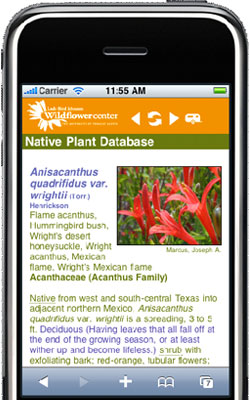
Did you know you can access the Native Plant Information Network with your web-enabled smartphone?

BOTANICAL GLOSSARY
Glossary of commonly used botanical terms and their definitions. Use the search bar below to look up a botanical term.
15 Random Botanical Terms
Lobed flower - A tubular or funnel shaped flower that opens into petal like lobes.
Hermaphroditic - Having the properties of a hermaphrodite, with both male and female structures located within the same flower.
Dioecious - With male and female reproductive structures on separate plants.
FACU* - Facultative Upland - Nonhydrophyte. Usually occurs in non-wetlands, but may occur in wetlands. Occurs only in the South Pacific Islands subregion.
Orbicular - Circular or nearly so.
Disc flowers - The inner tubular flowers on the heads of Asteraceae (Sunflower Family).
Umbel - A rounded or flat topped cluster of flowers on stems that radiate from the tip of the main stem. A compound umbel has smaller umbels at the ends of the radiating stems.
Complete flower - A flower with sepals, petals, stamens, and pistil present.
Parallel - A leaf whose veins run in parallel from the stem.
Supports Conservation Biological Control - A plant that attracts predatory or parasitoid insects that prey upon pest insects.
Pistillate flower - A flower with pistils, but no stamens.
Acorn - A usually one-seeded (occasionally two-seeded) nut enclosed in a hard, leathery shell and subtended by a scaly cup. The fruit of any species in the genera, Quercus or Lithocarpus.
Glabrous - Smooth; hairless.
Lenticel - A corky pore in young bark.
Emarginate - Having a shallow notch at the tip.