Native Plants

Q. Who is Mr. Smarty Plants?
A: There are those who suspect Wildflower Center volunteers are the culpable and capable culprits. Yet, others think staff members play some, albeit small, role. You can torture us with your plant questions, but we will never reveal the Green Guru's secret identity.
Did you know you can access the Native Plant Information Network with your web-enabled smartphone?

Ask Mr. Smarty Plants
Ask Mr. Smarty Plants is a free service provided by the staff and volunteers at the Lady Bird Johnson Wildflower Center.

rate this answer

Saturday - August 10, 2013
From: Chippewa Falls, WI
Region: Midwest
Topic: Invasive Plants, Shade Tolerant
Title: Plants to replace Polygonum cuspidatum ( Japanese knotweed)
Answered by: Nan Hampton
QUESTION:
I live in a heavily wooed area of Chippewa Falls, WI. Our property is covered with Giant Japanese Knot Weed. We have been trying to get rid of it for years. We are finally going to try using the dreaded, Round UP, after trying many natural techniques and solutions over the years to no avail. Even covering them up with dark AND clear plastic sheets hasn't worked. We are wondering what sort of fast growing/spreading ground cover we could plant to try to crowd out what may survive of the knot weed once we use the chemicals. What might we seed the area with that would be native to our area? We have deep shaded wooded areas, with a few depressions of standing water with hard rains. Also have shady and sunny areas up next to the house where the knot weed is prolific. Thank you for any suggestions.ANSWER:
Polygonum cuspidatum [synonym=Fallopia japonica] (Japanese knotweed) appears on the Plant Conservation Alliance's (PCA) Alien Plant Working Group's LEAST WANTED list. Please read their "Management Options" sections for control methods. The USDA Plants Database has a distribution map for North America plus a list of states (under "Legal Status") where it is considered prohibited, banned, invasive or noxious. We do understand you have a serious problem here. There is an Invasive Plants Association of Wisconsin that has a website with a great deal of useful information, including a list of Regional and County Groups that deal with invasives in Wisconsin.
Now, with that said, finding species that will "outcompete" this very tough plant (according to the PCA's LEAST WANTED web page "can tolerate a variety of adverse conditions including full shade, high temperatures, high salinity, and drought") is not going to be an easy task. We can recommend species that will do well in the conditions you give for your site, but you are going to have to continue to be vigilant and deligent in removing/destroying the knotweed as it reappears. Sorry to deliver that bad news—but you probably already realized that was going to be the case.
Let's start with suggestions for the deep-shaded wooded areas with moist soil:
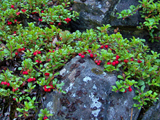
Arctostaphylos uva-ursi (Kinnikinnick) is a trailing evergreen shrub that makes a good groundcover in shady areas. It will also grow in sun and part shade.
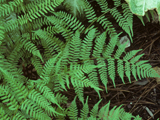
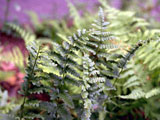
Adiantum pedatum (Northern maidenhair) and Athyrium filix-femina (Common ladyfern) are deciduous ferns.
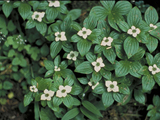
Cornus canadensis (Bunchberry dogwood) makes an excellent low groundcover in shady woods.
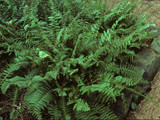
Dryopteris cristata (Crested woodfern) is a partially evergreen fern that grows in sun, part shade and shade.
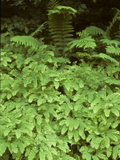
Hydrophyllum virginianum (Eastern waterleaf) grows in part shade and shade in moist woods and is labeled as an "aggressive grower"—a good candidate for competing with the Japanese knotweed. Here are more photos and information from Robert W. Freckman Herbarium University of Wisconsin.
Polystichum acrostichoides (Christmas fern) is an evergreen, clumping fern.
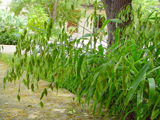
Chasmanthium latifolium (Inland sea oats) is one of the few grasses that grow well in shade. It is said to be aggressive in spreading. Here is more information from Missouri Botanical Garden.
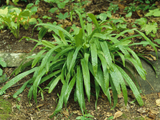
Carex plantaginea (Plantainleaf sedge) is an evergreen grass-like plant. Here is more information from Illinois Wildflowers.
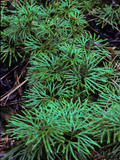
Lycopodium digitatum (Fan clubmoss) is an evergreen, low growth plant with a spreading habit. Here is more information from Illinois Wildflowers.
You can search for more possibilities by doing a COMBINATION SEARCH in our Native Plant Database. Choose "Wisconsin" from Select State or Province, "Shade" from Light Requirement, "Moist" from Soil Moisture and both "0-1 ft" and "1-3 ft" from Size Characteristics. You, of course, can change or add characteristics for your search. For instance, choose "Sun" from Light Requirement for the areas near your house.
Prairie Nursery in Westfield WI has Native Ground Covers for sale as well as other native plants. Prairie Moon Nursery in neighboring Minnesota has native seeds and seed mixes for sale (e.g., Shady Woodland Seed Mix for Wet Mesic to Dry Mesic Soils). You can find more nurseries and seed companies that specialize in native plants in your area by search in our National Suppliers Directory.
From the Image Gallery

More Invasive Plants Questions
Butterflies attracted by Pink Evening Primrose from Burnet TX
July 30, 2012 - I see information on Pink Evening Primrose that says it attracts 'many butterflies'
Please tell me which butterflies and name them? I've looked everywhere and am just exhausted and frustrated with...
view the full question and answer
Landscaping in the Southern California desert.
October 16, 2007 - We are located in southern California in Lake Havasu. I'm trying to landscape sloping areas. I have arrow weeds (Pluchea sericea) and want to get rid of them permanently. How can I achieve this or...
view the full question and answer
Non-blooming wisteria in Oklahoma
June 24, 2008 - I have a wisteria bush that doesn't bloom. It's two years old. What should I do?
view the full question and answer
Is Gooseneck native from Cleveland Heights OH
July 20, 2012 - I live in Cleveland Heights, OH, and have an abundance of gooseneck in my yard. Is it a native plant?
Thank you!
view the full question and answer
Controlling switchgrass in Fredericksburg TX
June 12, 2010 - How do you kill switch grass..too much has grown on our property. Originally planted to stop erosion due to oak wilted trees lost on hill behind house, which worked,but now it is everywhere.
view the full question and answer
| Support the Wildflower Center by Donating Online or Becoming a Member today. |