Native Plants

Q. Who is Mr. Smarty Plants?
A: There are those who suspect Wildflower Center volunteers are the culpable and capable culprits. Yet, others think staff members play some, albeit small, role. You can torture us with your plant questions, but we will never reveal the Green Guru's secret identity.
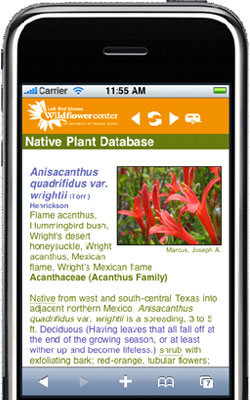
Did you know you can access the Native Plant Information Network with your web-enabled smartphone?
Ask Mr. Smarty Plants
Ask Mr. Smarty Plants is a free service provided by the staff and volunteers at the Lady Bird Johnson Wildflower Center.

rate this answer

Monday - June 24, 2013
From: Austin, TX
Region: Southwest
Topic: Non-Natives, Pruning, Shrubs
Title: Pruning non-native Chinese fringe flower from Austin
Answered by: Barbara Medford
QUESTION:
When is the best time of year to prune Plum Delight? And how severely can it be cut back?ANSWER:
Here is an article from Ask.com on How to Grow Plum Delight, also known as Lorapetalum chinense, Chinese Fringe Flower. This plant is native to, well, China, as well as Japan and southeast Asia. The Lady Bird Johnson Wildflower Center, home to Mr. Smarty Plants, is committed to the growth, protection and propagation of plants native not only to North America but to the area in which those plants are being grown; in your case, Travis County. We do this to ensure that you have the proper soil, climate and rainfall in your garden to accommodate the plants on which you spend precious resources. Since we do not have it in our Native Plant Database, we have to rely on information we can find on the Internet, as can you.
An article from Clemson University Extension on Lorapetalum has a couple of lines you should be interested in, but you should read the whole article.
"Root rot can be an issue, especially in poorly drained soils. In addition, leaves may become chlorotic (yellow) in alkaline (pH greater than 7.0) soil." The Austin area is notorious for alkaline soils and poorly draining clay, which is why we would not recommend this plant for Austin, even if it were native.
"Transplanting easily from containers, their preferred growing conditions include sun to partial shade (especially afternoon shade) and moist, well-drained, acidic soil with plenty of organic matter. They benefit from being mulched. Once established, they are very tolerant of drought conditions. Loropetalums respond well to a light application of slow-release fertilizer in early April and again in early June. Planted in the right location, they do not require pruning; however, they tolerate even heavy pruning very well. When necessary, prune in the spring after bloom so as not to reduce flowering the following spring."
More Non-Natives Questions
Non-native Sago palm roots damaging house foundation from Keystone Heights FL
July 03, 2013 - Will sago palms roots hurt a house's foundation if too close?
view the full question and answer
Native Species List for Ponca OK
June 24, 2011 - I planted daylilies in my Austin garden and did not do well. I moved these daylilies to my garden in Ponca City Oklahoma and have done outstanding relying only on mother nature's rain. My garden in ...
view the full question and answer
Privacy screening from Phoenix AZ
April 14, 2013 - I live in the center of Phoenix, Az. On the eastern side of my house we have some 2 story condos next door. The width of the side yard is about 12'-15' and it gets lots of shade. I also have my powe...
view the full question and answer
Non-native bougainvillea in Beaufort SC
July 06, 2011 - Bougainvillea-Can I grow these in Beaufort SC?
view the full question and answer
Non-native, invasive Arctium minus in New York
June 13, 2006 - For as long as I can remember, my family has been picking and eating a wild plant which we and other Italian families call " cardoons". I've often heard to it referred to burdock but no one knows t...
view the full question and answer
| Support the Wildflower Center by Donating Online or Becoming a Member today. |