Native Plants

Q. Who is Mr. Smarty Plants?
A: There are those who suspect Wildflower Center volunteers are the culpable and capable culprits. Yet, others think staff members play some, albeit small, role. You can torture us with your plant questions, but we will never reveal the Green Guru's secret identity.

Did you know you can access the Native Plant Information Network with your web-enabled smartphone?

Ask Mr. Smarty Plants
Ask Mr. Smarty Plants is a free service provided by the staff and volunteers at the Lady Bird Johnson Wildflower Center.

rate this answer

Tuesday - July 02, 2013
From: San Antonio, TX
Region: Southwest
Topic: Erosion Control, Groundcovers
Title: Ground cover for a slope in San Antonio TX
Answered by: Nan Hampton
QUESTION:
Slope growing, no or little irrigation ground cover. The slope is probably greater than 30%. The area is currently a construction road at the base, cut into the hill. To re-establish with a ground cover that would be short enough not to need mowing. Pedestrians walk through the area so a short growth plant for safety. Prefer a bedding plant vs. grass.ANSWER:
It would be helpful to know whether the area is in sun (more than 6 hours of sun a day), part shade (2 to 6 hours of sun per day) or shade (less than 2 hours of sun per day). Since I don't know the sun situation on the slope, please be sure to read the information on GROWING CONDITIONS on each of the species pages that I recommend.
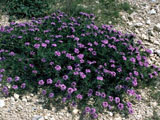
Glandularia bipinnatifida var. bipinnatifida (Prairie verbena) grows only 6-12 inches tall and has blooms from March through December.
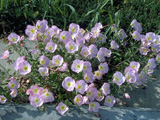
Oenothera speciosa (Pink evening primrose) is semi-evergreen and is usually a sprawling plant.
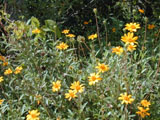
Wedelia texana (Zexmenia) should be evergreen in San Antonio. It blooms from June through November.
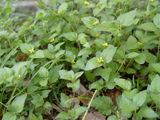
Calyptocarpus vialis (Straggler daisy) is semi-evergreen and usually grows to less than 1 foot.
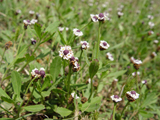
Phyla nodiflora (Texas frogfruit) is semi-evergreen and blooms May to October.
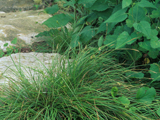
You might consider using one of the sedges. There are species that grow to less than 1 foot high and do well without irrigation after they are established. Here is more information about sedges from McNeal Growers in Austin. Here are two that are native to Bexar County:
Carex perdentata (Meadow sedge) grows in sun to about 8 inches high.
Carex planostachys (Cedar sedge) grows best in part shade to 6 inches high.
Using a combination of plants is your best bet. That way you will learn what will grow best on your slope and a mix of heights and colors will make the area more interesting. Any of the plants above will require irrigation to become established.
From the Image Gallery

More Groundcovers Questions
Natural groundcovers beneath live oaks in Austin
July 14, 2008 - We are moving to a home in NW Austin set in a forest of live oaks (15 of them). What plants are the natural groundcovers? We want to replace the 'grass' completely. There is no sun so we don't b...
view the full question and answer
Santa Fe orchard groundcovers
September 05, 2008 - Howdy
We were wondering what kind of ground cover you would suggest to use in a sunny area that has a few new apple trees [7' high]. The area is about 80' x 100 '. The soil is clay & was used to ...
view the full question and answer
Groundcover beneath a maple
January 24, 2009 - I am looking for something to spread out in the shade of a maple tree. I have tried lily of the valley, ferns, pachysandra, ivy, hosta, euonymus.. nothing spreads out.
view the full question and answer
Non-native invasive chickweed in Collegeville PA
December 31, 2011 - My problem is chickweed. I have found considerable information on how to eliminate the chickweed. My question is after following a suggested elimination process: How and when do I reseed with grass?...
view the full question and answer
Recovering neglected garden space from Grapevine TX
March 22, 2014 - I live in Grapevine TX (Dallas). I just moved into a house where almost the entire large backyard is covered by oak trees that shed tons of leaves throughout our mild falls/winters. The yard has not...
view the full question and answer
| Support the Wildflower Center by Donating Online or Becoming a Member today. |