Native Plants

Q. Who is Mr. Smarty Plants?
A: There are those who suspect Wildflower Center volunteers are the culpable and capable culprits. Yet, others think staff members play some, albeit small, role. You can torture us with your plant questions, but we will never reveal the Green Guru's secret identity.

Did you know you can access the Native Plant Information Network with your web-enabled smartphone?

Ask Mr. Smarty Plants
Ask Mr. Smarty Plants is a free service provided by the staff and volunteers at the Lady Bird Johnson Wildflower Center.

rate this answer

Monday - May 20, 2013
From: Austin, TX
Region: Southwest
Topic: Invasive Plants, Pruning, Shrubs, Trees
Title: How to deal with suckers on Flame-leaf Sumac
Answered by: Jimmy Mills
QUESTION:
Hi! It seems you can have too much of a good thing! Our flameleaf sumac is taking over our yard. There are multiple shoots appearing in our flower beds and in the lawn. How do I get rid of the unwanted growth in a safe and environmentally responsible way? The underground root appears to be quite hardy.ANSWER:
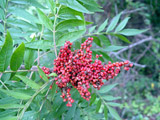
The Flame-leaf Sumac Rhus lanceolata (Prairie flameleaf sumac) is described as thicket-forming, small deciduous tree. The reason it forms thickets is because it produces numerous suckers. You are in for a elongated campaign if you are going to rid your yard of this pretty nuisance. I’m going to provide you with several links that will help you understand more about your adversary.
biology and eradication with herbicide
a description of root barriers
And finally, someone who enjoys Sumac;
From the Image Gallery

More Pruning Questions
Removing Center Stem From Desert Spoon (Sotol) in Phoenix
March 11, 2016 - I have a desert spoon. I hate the center stem. Can I remove the center stem without hurting the rest of the plant? And what is the best way to remove it? I looked for this answer in your questions bu...
view the full question and answer
Is Liatris spicata through blooming from Norman OK
July 26, 2011 - We have a Liatris spicata, I thought it was done blooming (dried tops), so I cut them off. Will it come back and bloom again? What can I do?
view the full question and answer
Fruit on Jasmines
March 13, 2013 - My jasmines have grown some small purple fruits and she is about to get her full bloom soon. Should I cut them off to help the plants out? What are they?
view the full question and answer
Trimming Butterfly Plants
February 11, 2013 - I am looking for detailed information on trimming common butterfly plants: crucita, cenizo, sweet-stem, whitebrush, Mexican trixis, skeleton-leaf goldeneye, white plumbago, turk's cap, desert lantana...
view the full question and answer
Can Monterrey Oak be topped into a bush from Austin TX
June 16, 2013 - I received a suggestion to use Monterey oak as privacy hedge by topping the small tree and letting it bush. I can't find any pictures or info on this being done though.
view the full question and answer
| Support the Wildflower Center by Donating Online or Becoming a Member today. |