Native Plants

Q. Who is Mr. Smarty Plants?
A: There are those who suspect Wildflower Center volunteers are the culpable and capable culprits. Yet, others think staff members play some, albeit small, role. You can torture us with your plant questions, but we will never reveal the Green Guru's secret identity.

Did you know you can access the Native Plant Information Network with your web-enabled smartphone?

Ask Mr. Smarty Plants
Ask Mr. Smarty Plants is a free service provided by the staff and volunteers at the Lady Bird Johnson Wildflower Center.

rate this answer

Wednesday - February 06, 2013
From: Austin, TX
Region: Select Region
Topic: Non-Natives, Pruning, Herbs/Forbs
Title: Pruning pink skullcap and rock daisy from Austin
Answered by: Barbara Medford
QUESTION:
I have some pink skullcap and rock daisy and other plants in my yard that never entirely die back over the winter. Can you tell me what kind of pruning is appropriate? How far can/should I cut them back? I don't want to kill them, and getting just dead leafless branches out of them is not really practical. Please help!ANSWER:
This is why Smarty Plants struggles with common names of plants. The same plant, sometimes in several different states or even countries, may have half a dozen different common names. For instance:
From Koala Native Plants on Brachyscome multifida (rock daisy). This is an Australian native and, we presume, not the one you have in your garden
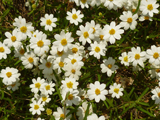
Melampodium leucanthum (Blackfoot daisy) (also called rock daisy)
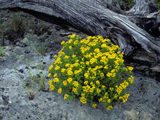
Perityle lindheimeri (Lindheimer's rockdaisy)
Here is a previous Smarty Plants answer on Pink skullcap from Central Texas Gardener.
After studying our webpages on the two that are native, and the Scutellaria suffretescens (Pink Skullcap) which may or may not be native, we are concluding that all are moderately low-growing perennials which will grow well in Austin.
Our advice on pruning perennials is pretty standard. Even if they are evergreen and certainly if they are not, they can take a good pruning in late winter. We like to leave about 6 inches of stems or branches standing on the ground. New green growth will quickly begin to show at the roots, but the standing branches will remind you that this is not a weed that needs yanking coming up. Because the plant needs leaves to provide food for the plant and blooms to produce seeds to propagate the plant, it will get busy putting on new, more vigorous growth. The plant doesn't care what its name is, it's just doing its thing.
From the Image Gallery
More Pruning Questions
Trimming a bur oak in Llano, TX
February 06, 2009 - We have a beautiful, large Burr Oak next to our house. This tree has many large lateral branches. I have trimmed dead branches, but no other trimming. It grows a lot of "suckers" during growing sea...
view the full question and answer
Pruning Saucer Magnolia in Eatontown, NJ.
January 12, 2013 - Adult Saucer Magnolia (tulip tree). Branches were getting heavy to where they were ready to break. I pruned them back leaving 1 to 3 inch diameter cuts on many branches. Should I put something on th...
view the full question and answer
Pruning of Bauhinia lunarioides
May 29, 2008 - I have a Bauhinia variegata..when is the best time to prune it? it tends to grow horizontally..where do you clip off the limbs?
view the full question and answer
Deadheading a petunia and why
July 13, 2008 - Can you please tell me the correct way to de-head a petunia and why?
view the full question and answer
Non-Blooming Bridal Wreath Spirea in PA
April 23, 2015 - We have 12 - 15 Bridal Wreath Spirea across our backyard. We have lived here for about 10 years (the plants longer). They have always bloomed except last year (2014) several didn't bloom and this y...
view the full question and answer
| Support the Wildflower Center by Donating Online or Becoming a Member today. |