Native Plants

Q. Who is Mr. Smarty Plants?
A: There are those who suspect Wildflower Center volunteers are the culpable and capable culprits. Yet, others think staff members play some, albeit small, role. You can torture us with your plant questions, but we will never reveal the Green Guru's secret identity.

Did you know you can access the Native Plant Information Network with your web-enabled smartphone?

Ask Mr. Smarty Plants
Ask Mr. Smarty Plants is a free service provided by the staff and volunteers at the Lady Bird Johnson Wildflower Center.

rate this answer

Wednesday - January 30, 2013
From: Elmendorf, TX
Region: Southwest
Topic: Edible Plants, Trees
Title: Texas native peach from Elmendorf TX
Answered by: Barbara Medford
QUESTION:
Does Texas have a native peach tree that grows wild?ANSWER:
Prunus andersonii (Desert peach), as shown in this USDA Plant Profile as native only to California and Nevada.
Prunus texana (Peachbush) - USDA Plant Profile shows it is native to Bexar County, TX.
These native Texas trees have other common names, including Sand Plum, Texas Plum and Texas Peach Bush. The peaches you see in the grocery store are also members of the Prunus genus, but Prunus Persica, which is the commercially grown peach, is native to China and southern Asia.
If you grow the Prunus texana (Peachbush), you need to remember that all parts of a Prunus are poisonous except the flesh of the fruit, and even in that, the seed is poisonous. In other words, a Texas peach bush shedding leaves or twigs could be a poisoning danger to pets or livestock. We could not find any information about the taste or texture of the fruit of this plant. We suggest you contact the Texas A&M Agrilife Extension for Bexar County. County extension offices tend to have more information on raising edible plants. There is contact information on that webpage.
From the Image Gallery
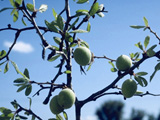
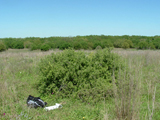
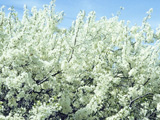
More Edible Plants Questions
Who ate the Jack-in-the-Pulpit in Ontario?
July 07, 2009 - Something has dug up my clump of Jack-in-the-pulpit at my parents' cottage in the Haliburtons (Ontario, Canada). Leaves, berries and roots are gone. We know we have a black bear who likes our compo...
view the full question and answer
Is the fruit of Melothria pendula edible?
November 22, 2014 - Is the fruit of Melothria pendula edible?
view the full question and answer
Dog eats Celtis laevigata, sugar hackberry
May 21, 2012 - This is an odd question but I am a biologist and have for years notice an odd behavior in my Golden Retriever. When he gets stomach distress or something makes him nervous like an incoming thunderstor...
view the full question and answer
Are wild sweet peas edible?
August 05, 2010 - Are wild sweet peas edible?
Thanks.
view the full question and answer
Edible plants in northeastern Ohio
February 12, 2009 - I am doing a project and i was wondering what are five native edible plants to the northeastern Ohio region. Also if you could tell the seasons they are available. Thank You,
view the full question and answer
| Support the Wildflower Center by Donating Online or Becoming a Member today. |