Native Plants

Q. Who is Mr. Smarty Plants?
A: There are those who suspect Wildflower Center volunteers are the culpable and capable culprits. Yet, others think staff members play some, albeit small, role. You can torture us with your plant questions, but we will never reveal the Green Guru's secret identity.

Did you know you can access the Native Plant Information Network with your web-enabled smartphone?

Ask Mr. Smarty Plants
Ask Mr. Smarty Plants is a free service provided by the staff and volunteers at the Lady Bird Johnson Wildflower Center.

rate this answer

Friday - November 23, 2012
From: Del Rio, TX
Region: Southwest
Topic: Plant Identification, Edible Plants, Medicinal Plants, Vines
Title: Identification of a vine in El Paso, Texas
Answered by: Nan Hampton
QUESTION:
I live in Del Rio Texas - Zone 8/9 and I have a vine which can't be identified. It looks like a morning glory white flower with crimson throat, but the leaf pattern is like a 5-7 fingered hand with dark green leaves. There are green seed pods which dry up and then produce large black seeds about 3-4 per pod. It is a climbing vine and just kinda took over my picket fence. I have seen it all over town. It is not a Queens crown and it far more hardy than my other vines.ANSWER:
This sounds like Merremia dissecta (Alamo vine). The Texas County Distribution Map from the USDA Plants Database doesn't show it as occurring in El Paso County. The nearest occurrence shown is for Presidio County. However, the USDA Plants Database doesn't show occurrences of ornamental plants. If you Google "Merremia dissecta seeds", you will see that there are lots of sources for the seeds worldwide and it is grown as an ornamental worldwide. Daniel Austin in his paper [Austin, Daniel F. 2007. Merremia dissecta (Convolvulaceae): Condiment, Medicine, Ornamental, and Weed—A Review. Economic Botany 61 (2):109-120] describes a fence near the edge of Tuscon covered with the vine. His article also describes medicinal and condiment uses for the plant—leaf infusions used as a sedative and leaf extract smells and tastes like almonds. Although there is some controversy, it is probably native to the Caribbean, Florida (perhaps Georgia), Texas, Mexico, Central and South America. Shiners & Mahler's Illustrated Flora of North Central Texas (page 558) considers it to be native as far north as Travis County in Texas. The distribution map in Austin's paper shows it occurring (introduced) across Africa, Asia and Australia where it was introduced as an ornamental and escaped to become naturalized. It is also grown as an ornamental in Europe.
From the Image Gallery
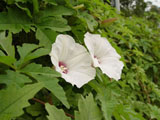
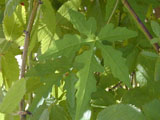
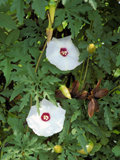
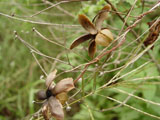
More Medicinal Plants Questions
Medicinal purposes of the common pepper
December 07, 2006 - Hello. I am a student at North Harford High School in Harford County, Maryland. I am currently doing a project in environmental science which requires me to do an interview, or at least ask some que...
view the full question and answer
Identifying a plant similar to sarsaparilla
September 04, 2011 - I am trying to identify a plant that looks very similar to sasparilla, but has a ring of blue berries at the end of a long stalk, and the plant itself is spreading, not an isolated herb like sasparill...
view the full question and answer
Lippia alba for sale at Wildflower Center
June 09, 2013 - Do you have this plant for sale Lippia Alba. thanks
view the full question and answer
Use of cenizo (Leucophyllum frutescens) for tea
February 20, 2006 - Back in the 50's when I spent the summers with my grandmother south of Hondo, Texas, she use to pick leaves from the cenizo (purple sage) bushes, dry them and then brew them for tea. I asked one of m...
view the full question and answer
Dumb question about prickly pear
December 23, 2005 - This is probably a really dumb question but I am interested in picking the prickly pear next year when it is in season, and was wondering the best way to get all of the little stickers off of the pear...
view the full question and answer
| Support the Wildflower Center by Donating Online or Becoming a Member today. |