Native Plants

Q. Who is Mr. Smarty Plants?
A: There are those who suspect Wildflower Center volunteers are the culpable and capable culprits. Yet, others think staff members play some, albeit small, role. You can torture us with your plant questions, but we will never reveal the Green Guru's secret identity.

Did you know you can access the Native Plant Information Network with your web-enabled smartphone?

Ask Mr. Smarty Plants
Ask Mr. Smarty Plants is a free service provided by the staff and volunteers at the Lady Bird Johnson Wildflower Center.

rate this answer

Monday - September 24, 2012
From: Temple, TX
Region: Southwest
Topic: Transplants, Shrubs
Title: Transplanting Silverado Sage from Temple TX
Answered by: Barbara Medford
QUESTION:
Hello, I've got some mature Silverado Sage. Can they be successfully transplanted or do I need to buy new plants for the next residence? I have them planted in a raised bed. I realize that IF it is TRANSPLANTABLE, I'll probably have to cut it back down to half when it's dug up. I just don't know if it will transplant successfully. Going to buy some Lowery Legacy Sage to plant at the next residence. Should it be planted above ground with average soil packed around it. Intentions are to cover it with mulch. I'll be buying products from the Brazos River Authority for packing in around them. It's composted sewer sludge. I'm not sure if LL Sage would prefer average soil instead. Thanks for all your help. TxDOT has bought my house and I have to get all my bulbs and planted transplanted off the property so they can bulldoze it down ASAP.ANSWER:
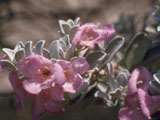
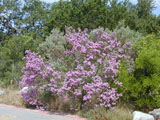
When we think of "sage," we think of members of the genus salvia, as in Salvia azurea (Pitcher sage), Salvia coccinea (Scarlet sage), and Salvia farinacea (Mealy blue sage). What you have is Leucophyllum frutescens (Cenizo). Silverado Sage is a trade name for a selection of this plant with the name of Leucophyllum frutescens (Cenizo) 'Silverado Sage.' The salvias, of course, are all herbaceous blooming plants and the cenizo is a perennial evergreen shrub. Note from this USDA Plant Profile Map that cenizo does not grow natively in Bell County, but does one county away in Williamson Co., and you obviouly have been growing it there, so that should not concern you.
But, the basic plant is still native to Texas, so first follow this link to our webpage on Leucophyllum frutescens (Cenizo) for general instructions on care and propagation. Note these Growing Conditions:
"Water Use: Low
Light Requirement: Sun , Part Shade
Soil Moisture: Dry
Cold Tolerant: yes
Heat Tolerant: yes
Soil Description: Rocky, well-drained soils. Limestone-based, Sandy, Sandy Loam, Medium Loam, Clay Loam, Clay, Caliche type
Conditions Comments: According to legend, cenizo tends to bloom in conjunction with rainfall. Cenizo is easy to grow so long as it has good drainage. Though this species is the most irrigation-tolerant of the genus, it is susceptible to cotton root rot if soil does not have good drainage and remains moist. Humidity and high night temperatures are lethal. Cenizos should not be fertilized or over-watered. Drought- and heat-tolerant. During very cold winters, may lose a few leaves."
We realize you have a time crunch, but it would be better if you could wait until cooler weather to transplant, which is what we recommend for all woody plants. Here are some links to transplanting instructions.
Gardenguides.com How to Transplant Silverado Sage
Previous Mr. Smarty Plants answer
We would add that you should note carefully the need for good drainage for this plant. We like to recommend the addition of some compost to the soil, which both assists in the drainage and helps the new little rootlets to access the nutrients in the soil.
On the subject of Leucophyllum langmaniae 'Lowery Legacy Sage' we do not find a species langmaniae of the genus Leucophyllum in our Native Plant Database, nor could we locate it as a species of the genus from anywhere else, so we are concluding that is just another name for a selection of Leucophyllum frutescens (Cenizo) and the same instructions should apply.
Texas Superstar Lowery's Legacy Cenizo
As for planting your shrubs in the materials provided to pack them in, they aren't going to hurt the plants, but all natives prefer the native soil around them. If the sewer sludge is well-composted, then we think that would count as the compost we recommend you add, but have no experience with it.
From the Image Gallery

More Transplants Questions
Damaged newly planted Gaura in Austin
April 16, 2010 - Hello yet again!
This past Friday we attended the plant sale where we got lots of goodies to start a new bed.
The plants were all planted on Sunday. All of them are doing fine, even beginning to...
view the full question and answer
Care of recently propagated Century Plant from Litchfield Park AZ
April 24, 2011 - To germinate some century plant seeds I put them in dirt and put the pot in a tray of water. Now, I have 3 sprouts about an inch tall and they came up about an inch apart. Question is, how should I w...
view the full question and answer
What plants can be moved from Romulus MI to Cleveland TX?
May 07, 2010 - I presently live and garden in Michigan, but will be re-locating in the next year to Cleveland Texas. What plants, if anything, can or should I bring to Texas?
view the full question and answer
What is the best time of year to transplant a young pecan tree?
May 29, 2009 - What is the best time of year to transplant a young pecan tree?
view the full question and answer
Dead woody plants in wildlife garden in Austin
March 02, 2011 - I am an enthusiastic and pretty successful wildlife gardener, have studied my Wasowski "Bible", but I can't get any evergreens established in my yard! We live on blackland clay, which I amend with ...
view the full question and answer
| Support the Wildflower Center by Donating Online or Becoming a Member today. |