Native Plants

Q. Who is Mr. Smarty Plants?
A: There are those who suspect Wildflower Center volunteers are the culpable and capable culprits. Yet, others think staff members play some, albeit small, role. You can torture us with your plant questions, but we will never reveal the Green Guru's secret identity.

Did you know you can access the Native Plant Information Network with your web-enabled smartphone?

Ask Mr. Smarty Plants
Ask Mr. Smarty Plants is a free service provided by the staff and volunteers at the Lady Bird Johnson Wildflower Center.

rate this answer

Saturday - August 18, 2012
From: Palm Coast, FL
Region: Southeast
Topic: Shrubs
Title: Non-flowering Tecoma stans from Palm Coast FL
Answered by: Barbara Medford
QUESTION:
I have an adult tecoma stans that flowered for a few days in the spring and has not flowered since. What can I do?ANSWER:
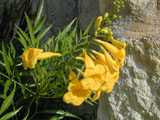
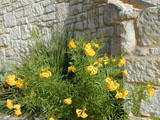
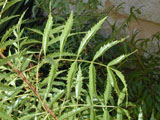
Tecoma stans (Yellow bells) is basically a desert plant. If you follow the plant link to our web page on this plant, you will learn that it is native to New Mexico, Arizona and Texas. This USDA Plant Profile Map shows that it also grows in Florida, in the southern tip of Florida and also Brevard County but not Flagler Co. Because Florida has such wonderful growing conditions, many plants are introduced there, and the Florida conditiions might not be ideal for them. As we said, they are desert plants and require extremely good drainage; water sitting on their roots can cause root rot. Also, most native plants do not need fertilizer and the Yellow Bells particularly dislikes it. If, in the process of trying to get it to bloom, you have fertilized it, possibly with a high nitrogen fertilizer, that could be the problem. High nitrogen fertilizers are intended for lawn grasses, as they inspire leaf production and not blooms. If all the energy of the plant is going into leaves, it doesn't have the resources for blooming. If you planted the shrub, and put in decomposed granite or compost in order to improve the drainage, then that takes care of that problem. If you did not plant it for good drainage, or it was already on your property, then we suspect that is the problem.
Was this the plant's first full season in the ground? It ordinarily blooms from April to November, but if it is a young plant it may not have matured sufficiently to bloom any more. It takes a great deal of energy for a plant to bloom, and if something is going on that is not favorable, the plant may be coping with that and not have the energy to bloom.
So, we would recommend, first of all, patience. Second, if you don't believe the plant has been properly planted for drainage, try to work a little compost into the soil around the roots, and cover the roots with more compost. As that compost decomposes, it will amend the soil and improve the drainage. Don't water too much, remember, desert plant, and no fertilizer.
One last thing, if Yellow Bells is not growing well in Flagler County, it could be a soil problem. From our webpage on this plant:
"Growing Conditions
Water Use: Low
Light Requirement: Sun , Part Shade
Soil Moisture: Dry
Drought Tolerance: High
Cold Tolerant: yes
Heat Tolerant: yes
Soil Description: Well drained, rocky, limestone, sand, and loam soils
Conditions Comments: Varieties sold in nurseries may be from tropical stock and not do so well in US cold. Yellow bells is drought tolerant and Southwestern varieties are adapted to monsoon rains with dry spells between. They may flower better if such conditions are emulated in planned landscapes, so allow ground to dry out between waterings. "
"Native Habitat: High elevations, hillsides, slopes, canyons"
From the Image Gallery
More Shrubs Questions
Plants for red clay in Hattiesburg, MS
May 16, 2011 - Looking for plants and flowers to plant in red clay?
view the full question and answer
Climbing options for a Coral honeysuckle in Austin Texas
April 16, 2013 - Regarding Coral honeysuckle, what is the best support to encourage continued spread, chicken-wire/fencing? Currently the plants and vines are on fencing and beginning to fold over. I'd like to add...
view the full question and answer
Flowering shrub for Kihei, Hawaii
August 12, 2015 - I live in Kihei Hawaii, near the beach but across the road from it. I am looking for a hedge that flowers, can be trimmed is dense and grows rather quickly. 3-4ft in height. We have bougainvillia now ...
view the full question and answer
Looking for shrubs to plant in Southern Illinois.
July 03, 2013 - Hi. I am in Southern Illinois. I'm needing small shrubs for a south facing area. It's a 14ft. long by 2ft. wide area. Although it's facing south, it's not real sunny. A huge tree and swing is...
view the full question and answer
Landscaping for a wedding in Memphis MO
October 13, 2009 - I am pretty new at this landscaping flower thing, but I love it. We just moved out to the country in NE Missouri from Colorado (Huge difference, but love it). We have decided to have our wedding at o...
view the full question and answer
| Support the Wildflower Center by Donating Online or Becoming a Member today. |