Native Plants

Q. Who is Mr. Smarty Plants?
A: There are those who suspect Wildflower Center volunteers are the culpable and capable culprits. Yet, others think staff members play some, albeit small, role. You can torture us with your plant questions, but we will never reveal the Green Guru's secret identity.

Did you know you can access the Native Plant Information Network with your web-enabled smartphone?

Ask Mr. Smarty Plants
Ask Mr. Smarty Plants is a free service provided by the staff and volunteers at the Lady Bird Johnson Wildflower Center.

rate this answer

Monday - July 30, 2012
From: Freehold, NJ
Region: Mid-Atlantic
Topic: Poisonous Plants, Problem Plants, Vines
Title: Poison ivy? vine in NJ
Answered by: Anne Bossart
QUESTION:
I have a vine growing among some vegetation in my backyard. It has a leaf with 3 "points" with ridges along its edges. The smaller leaves are reddish which is why I thought poison ivy but definitely looks nothing like pics I have found online. Looks vaguely like a maple leaf but more slender. Please help identifying it. I took pictures but don't know how to upload them.ANSWER:
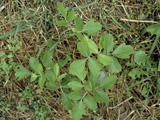
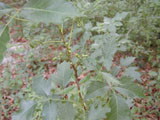
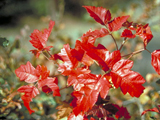
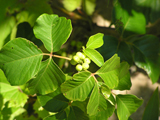
Poison ivy is a plant that has a very broad native range in North America and can have a varied appearance in different locations. Toxicodendron pubescens (Atlantic poison oak) looks different than Toxicodendron radicans (Eastern poison ivy) which looks different than Toxicodendron rydbergii (Western poison ivy) and none of the photos look like the poison ivy that I was familiar with in NJ/PA or see in Ontario. Not to mention that it grows in sun or shade and looks different under those conditions.
I have found in the "north" that the most conclusive identification features for poison ivy are the three leaves with redidsh sepals and stems (and yes, reddish new growth). Although all the photos in our database show leaves that have notched edges, I have seen it with almost completely smooth leaf margins with perhaps only one notch. I have also seen it look more like a zig-zag than a lobed edge.
My advice to you is ... if you think it might be, treat it like it is poison ivy. Spray it with weed killer (using a paper bag or cardboard to protect adjacent plants) or pull it using what I think of as the dog-poop&scoop method. When I lived in your area and used to find it popping up in my flower beds (the berries are a very important and plentiful food source for birds) I saved newspaper bags especially for pulling poison ivy seedlings as they are narrrow and protect your skin almost up to the elbow. The plant can be pulled out, the bag turned inside out as you remove it and the whole business disposed of.
Wash your hands (and garden clothes) thoroughly immediately if you think you may have come in contact with poison ivy, even if you have no reason to believe that you might be allergic to it.
From the Image Gallery
More Vines Questions
Vines for Austin, Texas
July 23, 2010 - I have heavy clay soil that is very wet during rainy season. I would like to plant climbing, blooming native. Crossvine and trumpet creeper are doing well but need another vine for an area that gets f...
view the full question and answer
Trumpet vines on wall in Longmont CO
May 18, 2010 - I purchased three trumpet vines to plant on the NW wall of my house back in 2002. Although the leaves are a beautiful healthy dark green, none of them have ever bloomed despite regular fertilizing pe...
view the full question and answer
Oak trees shedding leaves in Denton TX
May 27, 2012 - In Denton, TX we have two mature Quercus buckleyi. It is May 11th 2012 and one of these trees has been shedding green leaves for the last week. The only changes we have made are: planted English ivy...
view the full question and answer
Non-blooming of Campsis radicans, Trumpet Vine
August 25, 2006 - I have a trumpet vine that does not bloom. My neighbor has the same plant and it blooms profusely. I have pruned the vine in February as was suggested on another site. It is healthy and is planted a...
view the full question and answer
Plant for Erosion Control on Wooded Slope in MD
May 19, 2015 - We are looking for a plant to help with erosion control on a wooded slope next to our drive. The roots of several of the trees are exposed like a shelf, so I think it's a fairly severe problem. We ar...
view the full question and answer
| Support the Wildflower Center by Donating Online or Becoming a Member today. |