Native Plants
Q. Who is Mr. Smarty Plants?
A: There are those who suspect Wildflower Center volunteers are the culpable and capable culprits. Yet, others think staff members play some, albeit small, role. You can torture us with your plant questions, but we will never reveal the Green Guru's secret identity.
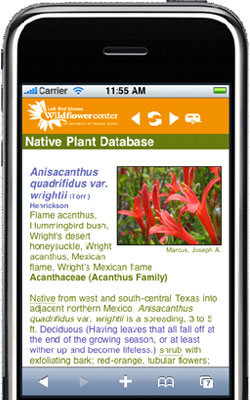
Did you know you can access the Native Plant Information Network with your web-enabled smartphone?
Ask Mr. Smarty Plants
Ask Mr. Smarty Plants is a free service provided by the staff and volunteers at the Lady Bird Johnson Wildflower Center.

rate this answer

Friday - June 22, 2012
From: Raleigh, NC
Region: Southeast
Topic: Plant Lists, Deer Resistant
Title: Need deer resistant plants for a shady north facing garden in Raliegh, NC.
Answered by: Jimmy Mills
QUESTION:
I am in need of Deer Resistant Native Shade plants for a North Facing Garden. It is 3 feet wide by 20 feet long. Any suggestions will be appreciated. Thank you, Eaten AliveANSWER:
If North Carolina deer are like Texas deer, they’ll pretty much eat anything when they are hungry. However, I’ve found some information that may give you a fighting chance. I’m going to give you several links to North Carolina Carolina Cooperative Extension which has an office in Wake County. The topics include plants lists, managing deer, and landscaping.
(a) plant lists
(b) managing deer
(c) landscaping
Once you have the names of some plants that you might use, you can check them out using our Native Plant Database. Go to the “Search native plants database”, type in the name, and click “go”. If it is a native plant, the NPIN page for that plant will come up, and you can learn about its size. light requirements, and other characteristics. Here’s a couple of examples. From the list in (a), we find Abelia, but when we type it in, we don’t get a page showing. This means it is not native. Another plant on that list is Yaupon. When we type that in, we get Ilex vomitoria (Yaupon). We find that it is a shrub, 12 - 36' tall, grows in sun, shade, or part shade, but not in Wake County. Another plant listed is Wax Myrtle Morella cerifera (Wax myrtle) .It is an evergreen shrub, grows in sun, partial shade, and is found in Wake County.
So with a little due diligence, you should be able to come up with a list of plants that will beautify your garden, and have the deer looking elsewhere.
More Plant Lists Questions
What thorny vine grows rapidly in Pensacola?
May 06, 2013 - What thorny vine grows rapidly in Pensacola?
view the full question and answer
Butterfly Plants for D.C. Garden
July 16, 2015 - I have one half of the side of the house face NE and the other half faces NW. The front of the house faces east. The back of the house faces west which is woody with native trees of Rock Creek Park of...
view the full question and answer
Need Plants and Soil for a Green Roof in Buffalo, TX
September 13, 2010 - I'm building a green roof on my cabin in the Buffalo, Texas, area. Would you know what soil and plants would be best suited for that area? I have a lot of sand I could use, but didn't know if that...
view the full question and answer
Climbing Roses for the Pacific Northwest
January 23, 2016 - I'm trying to find out which types of climbing roses may exist in the Pacific Northwest. I live in western Washington, and I have a small yard with several large hedges bordering it. I'm growing hai...
view the full question and answer
Source for records of Pleistocene flora of Central Texas
December 16, 2013 - Part of your answer to a question from October 12, 2010 is "..moreover, the evidence goes even further back than the 1800s. Studies of Pleistocene deposits from Central Texas showed ancestral cedar p...
view the full question and answer
| Support the Wildflower Center by Donating Online or Becoming a Member today. |