Native Plants

Q. Who is Mr. Smarty Plants?
A: There are those who suspect Wildflower Center volunteers are the culpable and capable culprits. Yet, others think staff members play some, albeit small, role. You can torture us with your plant questions, but we will never reveal the Green Guru's secret identity.

Did you know you can access the Native Plant Information Network with your web-enabled smartphone?

Ask Mr. Smarty Plants
Ask Mr. Smarty Plants is a free service provided by the staff and volunteers at the Lady Bird Johnson Wildflower Center.

rate this answer

Wednesday - June 27, 2012
From: New Carrollton, MD
Region: Mid-Atlantic
Topic: Erosion Control, Groundcovers, Grasses or Grass-like, Herbs/Forbs, Shrubs, Trees, Vines
Title: Plantings for a slope from New Carrollton MD
Answered by: Barbara Medford
QUESTION:
My house (Maryland, near DC) sits at the bottom of a south facing slope. The soil is very heavy clay. The grade is about 1:20 for about 100 feet (with a steeper part at the top). Part of the hill is in direct sun but most is part-shade. What native shrubs, trees and perennials can I plant that would have high wildlife value and control erosion? I don't want grasses because then I would have to mow them (no grasses higher than 8 inches allowed, even in meadows). Thanks very much in advance!!ANSWER:
First, read our How-To Article on Gardening with Native Plants. Next, since you specified high wildlife value, read our How-To Articles on Wildlife Gardening and Butterfly Gardening. We are not civil engineers so the slope values are a foreign language. You would have to make your own decisions on whether a tree would tolerate being planted on a sloped surface. Since we recommend only plants native not only to North America but to those areas where the plant grows naturally, we will go to our Native Plant Database and, using the parameters you have given us of sun (6 hours or more of sun a day) and part shade (2 to 6 hours), native to Maryland in the various habits (shrub, tree, herbaceous blooming perennials) and give you some examples for each. Once you have become acquainted with our Native Plant Database, you will be able to make your own selections. Follow each plant link on our list to determine the growing conditions for that plant, light, water needs, etc. before making a decision.
We would suggest that you first map out the sunny and/or part shade areas of your plot, watching it for a few days and noting the times on your map to make choices more relevant to the space. The clay soil is going to be a problem, and we recommend that you amend any area where you are planting with a good quality organic compost to assist in drainage and to allow the new young rootlets air space in the soil in which to extend. We regret that you have ruled out grasses, as they are the very best plants for controlling erosion, with their long fibrous roots. Just in case, we are going to recommend a couple of grasses that would not be mowed but are ornamental. We will also throw in a vine that might go at the top of the steeper slope and trail down and some low groundcovers.
So, we will begin with herbaceous blooming plant (herbs). First round, we will go to our Native Plant Database, select on Maryland, herbs for Habit, both sun and partial shade for Light Requirements. There are other specifications you can put in such as expected height, bloom color and time or soil moisture, but we can only use the conditions you listed. One last bit of advice, Summer is not a good time to be planting, especially the woody plants, trees and shrubs.
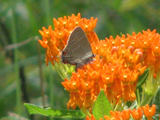
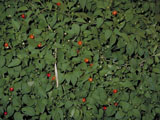
Herbaceous blooming plants - Asclepias tuberosa (Butterflyweed) and Capsicum annuum (Chile pequin)
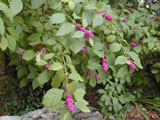
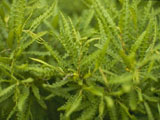
Shrubs - Callicarpa americana (American beautyberry) and Comptonia peregrina (Sweet fern)
Trees - Amelanchier laevis (Allegheny service-berry) and Cercis canadensis (Eastern redbud)
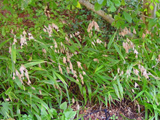
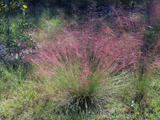
Grasses - Chasmanthium latifolium (Inland sea oats) and Muhlenbergia capillaris (Gulf muhly)
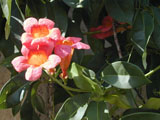
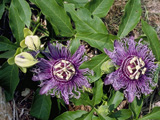
Vines - Bignonia capreolata (Crossvine) and Passiflora incarnata (Purple passionflower)
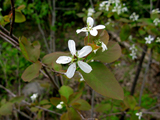
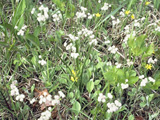
Low groundcover - Antennaria plantaginifolia (Plantain-leaf pussytoes) and Cornus canadensis (Bunchberry dogwood)
From the Image Gallery


More Shrubs Questions
Sprouts from stems of plants from Happy Yard IN
September 28, 2013 - Is it normal for a plant to start a sprout from its own root system next to the stock/stem? Is it trying to regrow?
view the full question and answer
Ground cover to withstand dog traffic in Michigan
November 02, 2010 - I need a soft ground cover that will grow in sand, and be able to take four big dogs that love to run in the yard. Grass just doesn't make it. Someone suggested that groundcover might work.
Thanks...
view the full question and answer
Planting under Pine Trees in Pocatello ID
April 08, 2014 - Hi I was wondering if you could give me some ideas of what I could plant under and near some pine trees for my area. The trees are huge and so it is also constant shade where I want to plant. Thanks f...
view the full question and answer
Plant identification of shrub in Georgia
May 26, 2010 - I have a bush that has red berries. It is evergreen and the leaves are a soft green. The berries are white at first and turn red. The bush is like a cluster of twigs that are in one area kind of li...
view the full question and answer
Hearty, bushy native plants for windowboxes in Abilene, TX
October 08, 2005 - I live in Abilene, Tx and am a horrible gardener. I would love to have window boxes with some sort of hearty bushy plant. Any suggestions, I'm at a total loss...? Thanks!
view the full question and answer
| Support the Wildflower Center by Donating Online or Becoming a Member today. |