Native Plants

Q. Who is Mr. Smarty Plants?
A: There are those who suspect Wildflower Center volunteers are the culpable and capable culprits. Yet, others think staff members play some, albeit small, role. You can torture us with your plant questions, but we will never reveal the Green Guru's secret identity.

Did you know you can access the Native Plant Information Network with your web-enabled smartphone?

Ask Mr. Smarty Plants
Ask Mr. Smarty Plants is a free service provided by the staff and volunteers at the Lady Bird Johnson Wildflower Center.

rate this answer

Monday - May 21, 2012
From: Quinwood, WV
Region: Mid-Atlantic
Topic: Plant Identification
Title: Mystery forest plant in WV
Answered by: Anne Bossart
QUESTION:
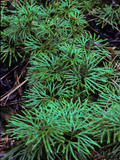
In the mountains of southern WV I have several acres of shady, moist land. It has never been developed and is COVERED with a low growing fern?ground cover?whatever. It creeps along on very shallow roots. It is about 3" tall, sometimes has a small yellow shoot which I think is its "flower". It turns yellow when it goes into the winter season, but comes back to lush, thick continuous green cover. I have had no luck at transplanting. The foliage makes me think of the needles of hemlock or another native evergreen. HELP! I have looked EVERYWHERE!ANSWER:
Although it is impossible to identify your plant without seeing it, we can make an educated guess and hopefully point you in the right direction.
From your description, we suspect that your plant is probably a Lycopodium sp. (commonly known as club moss or ground pine and ground cedar) and most likely Lycopodium digitatum (Fan clubmoss) It forms large colonies on hardwood forest floors and is very common throughout Appalachia. If you read the Wikipedia article about Lycopodium it will tell you more about the plant species. L. dendroideum and L hickeyi are also candidates that are native to West Virginia.
From the Image Gallery
More Plant Identification Questions
Drummonds wild onion growing along creek in St. Edwards Park
April 17, 2006 - I live near St Edwards Park in Austin and was wondering what the name of the onion is that grows along the creek. Thanks
view the full question and answer
Wildflower in southeastern Pennsylvania
May 20, 2008 - I live in southeastern Pennsylvania and want to identify a wild flower that is common along small town and rural roads and highways. It is blooming now (Mid May), has a flower spike similar to a larks...
view the full question and answer
Identification of old plant called pinks
February 28, 2008 - For years my mother had a pretty pink flower in her yard. It was in a little cluster of green leaf like bush. She just called them pinks. They would close in the sun and open in the morning or afte...
view the full question and answer
Plant ID in Flower Mound TX
June 23, 2009 - I have a large native tree in the back yard, leaves resembles a live oak, but evergreen,& small white flowers in the spring, very tall vase shaped tree. It had no acorns or berries.
view the full question and answer
Tree that looks like cedar elm but with smooth bark
August 09, 2014 - What tree looks like a cedar elm, but has smooth bark?
view the full question and answer
| Support the Wildflower Center by Donating Online or Becoming a Member today. |