Native Plants

Q. Who is Mr. Smarty Plants?
A: There are those who suspect Wildflower Center volunteers are the culpable and capable culprits. Yet, others think staff members play some, albeit small, role. You can torture us with your plant questions, but we will never reveal the Green Guru's secret identity.
Did you know you can access the Native Plant Information Network with your web-enabled smartphone?

Ask Mr. Smarty Plants
Ask Mr. Smarty Plants is a free service provided by the staff and volunteers at the Lady Bird Johnson Wildflower Center.

rate this answer

Sunday - April 29, 2012
From: Austin, TX
Region: Southwest
Topic: Invasive Plants, Vines
Title: Eradicating trumpet vine runners in Austin
Answered by: Barbara Medford
QUESTION:
How do I eradicate trumpet vine runners from my lawn? Will it kill my pecan tree?ANSWER:
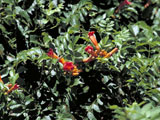
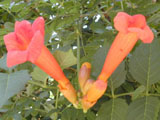
Campsis radicans (Trumpet creeper) is a native, colorful flowering vine, growing natively through most of North America, but most invasive in the Southeast. Follow the plant link to learn about the risks of having the plant in your yard.
Also, Dave's Garden, which is a forum, has 64 negative comments on the plant.
From Floridata, more comments on invasiveness of Campsis radicans.
Previous Mr. Smarty Plants answer
Conclusion: How to keep it from being invasive? Don't plant it and don't let it into your garden from anywhere else. It can definitely harm your pecan tree if it gets up in it and covers the leaves, preventing sunlight from reaching those leaves and also preventing photosynthesis, whereby the plant uses the energy of the sun to produce food for the plant as well as oxygen for our air.
Obviously, you already have it. We can pass along some of the suggestions for controlling it. First; patience. Even if you never get rid of it completely, it will only get worse if you don't stay after it year after year. Second: herbicide. Do NOT spray herbicide, this will only damage the tree, other desirable plants in your garden and the environment, but won't get close to all those Trumpet Vine roots underground. You say it's in your lawn-mow it, low and regularly. Mowing won't kill it, but it will slow it down. Get a bottle of an undiluted wide spectrum herbicide and some disposable sponge brushes. With garden nippers, clip off the stems close to the ground and immediately paint the cut edge of the stem in hopes you get it into the system of the vine before the cut place heals over in self defense. This makes it possible for the herbicide to actually get to the roots. Sometimes. If you have big roots going up a tree, by all means, pull them away, cut the vine and, again, paint the fresh cut with the herbicide.
The only way to keep a plant from being invasive is to never plant it.
From the Image Gallery
More Vines Questions
Flowers for monarch butterflies in Bastrop, Gonzales and Travis Counties of Texas
March 05, 2013 - Hi Mr./s. Smarty Plants,
What are some flowers that grow naturally on a Bastrop, Travis, or Gonzales county riverside that monarch butterflies commonly feed on?
Thank you
view the full question and answer
Vines for trellis in Livermore, CA
October 29, 2009 - I am looking for a native vine for a northern California location. It's Livermore California with a climate intermediate between the SF Bay and the Central Valley. Some frost in the winter. Maybe 10 ...
view the full question and answer
Control of invasive vine in North Carolina
November 18, 2009 - Hi, I live in Piedmont NC, have vines that twine around my shrubbery and are impossible to pull out of the ground w/o breaking because they are so thin/delicate. The leaves are maple-like (3 lobes), ...
view the full question and answer
Failure to thrive of passion flower in Tunbridge Wells England
April 08, 2013 - I planted my passion plant 3 years ago and I have really looked after it. I think this winter has killed it, it looks so dead. I hope it can be saved; there isn't one part of it that is looking healt...
view the full question and answer
Native vine for fence on youth baseball field
March 15, 2016 - Our community in Comanche, Texas would like to plant a native vine on the back fence of a youth baseball field. We have plans to plant an area of native grasses behind the fence, between the fence an...
view the full question and answer
| Support the Wildflower Center by Donating Online or Becoming a Member today. |