Native Plants
Q. Who is Mr. Smarty Plants?
A: There are those who suspect Wildflower Center volunteers are the culpable and capable culprits. Yet, others think staff members play some, albeit small, role. You can torture us with your plant questions, but we will never reveal the Green Guru's secret identity.
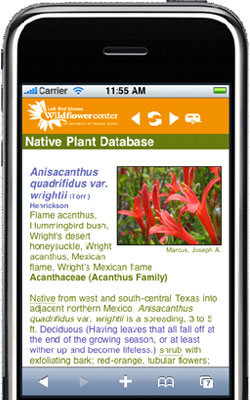
Did you know you can access the Native Plant Information Network with your web-enabled smartphone?
Ask Mr. Smarty Plants
Ask Mr. Smarty Plants is a free service provided by the staff and volunteers at the Lady Bird Johnson Wildflower Center.

rate this answer

Tuesday - April 24, 2012
From: Hendersonville, NC
Region: Southeast
Topic: Rain Gardens, Grasses or Grass-like, Herbs/Forbs, Shrubs
Title: Retention pond from Hendersonville NC
Answered by: Barbara Medford
QUESTION:
We have a retention pond that has recently been cleaned and we would like to plant perennial native plant and grass seeds that will enhance the appearance and contribute to the natural process of filtration, hold the soil when water is rushing by and permit pollutants in the water to be filtered out. What time of the year should the seed be planted and able to stand generally wet feet?ANSWER:
From the EPA, here is an article on National Pollutant Discharge Elimination System, which is about retention ponds.
With that in mind, we have two very similar questions in our queue; one is yours from North Carolina and another is from Michigan. We suggest you read the Michigan answers for some background information:
We found a previous Mr. Smarty Plants question originating from Virginia which we think might have some information of use to you. There are some more links to further information in that, and instructions on using our Native Plant Database. Since we don't know if you want all grasses, how moist your soils are, how much sunlight they will get, etc, we think it would be better if you made your own plant list. Native grasses are certainly the best choice as their long fibrous roots will definitely help to hold the soil. As for the time the seeds should be planted (or plants if you are putting in some shrubs) is dependant on the part of the country. In Texas, we recommend planting grass seeds in mid-April, and hoping for gentle consistent rains, which we seldom get. If you go down the webpage on each plant you are investigating to the bottom you will see a list of Additional Resources. Click on "Search Google for ______ (plant name). Sometimes the webpage will have specific Propagation Instructions on it.
More Rain Gardens Questions
Looking for native plants for a rain garden in Arlington, TX.
March 12, 2012 - I am looking for native Texas plants that would do well in rain gardens. Do you have any suggestions?
view the full question and answer
Plants for difficult site in Jacksonville, TX
July 07, 2010 - East Texas (Cherokee County) red clay hillside, hard-packed, difficult to get to, 40' of it slopes 4' down in about 6'! Another 30' of it is flat. Between the hillside and the flat clay area is a...
view the full question and answer
Managing a wet area in Austin
November 18, 2013 - I suspect that my backyard lies at the very top of a creek watershed. However, all of the water flowing through it gets blocked by a solid stone wall. Whenever we get a significant rain event, part ...
view the full question and answer
Plants for a pond edge in IN
June 08, 2012 - Hello, I live in Southern Indiana. I care very much about reinforcing native plants for my region & not planting anything invasive.
I had a pond built last year & need some suggestions for native ...
view the full question and answer
Plants for a ditch in PA
June 09, 2012 - I have a property in the suburbs about 20 miles south of Philadelphia, PA. There is a small creek running across the property. The "ditch" holding the creek is about 5 feet across, but the creek i...
view the full question and answer
| Support the Wildflower Center by Donating Online or Becoming a Member today. |