Native Plants

Q. Who is Mr. Smarty Plants?
A: There are those who suspect Wildflower Center volunteers are the culpable and capable culprits. Yet, others think staff members play some, albeit small, role. You can torture us with your plant questions, but we will never reveal the Green Guru's secret identity.

Did you know you can access the Native Plant Information Network with your web-enabled smartphone?

Ask Mr. Smarty Plants
Ask Mr. Smarty Plants is a free service provided by the staff and volunteers at the Lady Bird Johnson Wildflower Center.

rate this answer

Monday - April 16, 2012
From: Midland, MI
Region: Midwest
Topic: Wildlife Gardens, Trees
Title: Evergreens for a deer corridor in MI
Answered by: Anne Bossart
QUESTION:
I am growing three rows of evergreens for a wildlife, deer travel corridor, and am looking for which trees grow well together and are shade tolerant of each other when planted at the same time, or at intervals. My soil is a thin layer of sandy loam, over clay, so it may be wet or dry at different times of the year,depending on weather extremes. I am ordering trees thru the local soil conservation district, some of my choices are Blue Spruce, White Spruce,Norway Spruce,White Pine,Red Pine, Austrian Pine, and Douglas Fir. I would appreciate your suggestions on which evergreen species to plant together, and any planting intervals and instructions you may have. I am thinking of 7 feet intervals to provide good cover.ANSWER:
We applaud your efforts to provide a wildlife corridor joining fragmented habitat, even though you are helping a form of wildlife most gardeners are in constant conflict with! Habitat loss is the greatest threat to species biodiversity and joining habitat fragments as you are planning to, does make a difference.
Because your question is somewhat out of our area of expertise, we checked with a forestry expert.
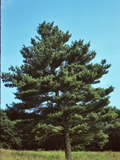
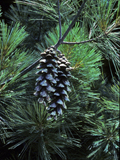
He recommends: "planting 3 rows of Pinus resinosa (Norway pine) (image here) 7X7' spacing and when they get established (3-5 years) spotting in some of the mid-tolerants such as Picea glauca (White spruce) (image here)and/or Picea rubens (Red spruce) (image here) and/or Pinus strobus (Eastern white pine). The red pine will provide some cover/shade for the more tolerant species. The deer will find their way through and not likely browse on any of these species (although I have seen browsing on white pine by moose).
Red pine will do fine on fine to coarse sands if there is enough depth to not cause root restriction and the soils are not calcarious. Once establshed red pine will put on 2-3' of height per year in full sun.
White cedar and eastern hemlock are good species for holding up the snow load but are also a favorite food species for deer."
The other plants you have asked about are not native to your region so we do not recommend planting them.
From the Image Gallery
More Wildlife Gardens Questions
Plants for no sun in Austin
May 12, 2010 - I need recommendations for shrubs that can withstand no sun, something that possibly blooms but does not attract bees, wasps, or any stinging insects (hummingbirds or butterflies ok).
view the full question and answer
Native landscaping and wildlife gardening in Clifton, TX
November 29, 2004 - I am moving to Clifton, TX, and I will have an empty lot in the town along with my own home/lot. What kind of soil can I expect? I want to grow a wildflower site to just sit and enjoy and feed the a...
view the full question and answer
Wildlife plants for backyard on Galveston Island
July 25, 2010 - Can you help me select native plants for Galveston Island that can be used in a backyard to attract native wildlife?
view the full question and answer
Keeping bugs out of a Texas home
June 29, 2015 - I'm slowly growing my gardens into natural habitats for birds, bees, butterflies and other little critters but would like to keep them outside of my house. Being in central Texas it is difficult to ...
view the full question and answer
Luring wildlife in Longview
March 27, 2005 - I live in Longview, Texas and am in the process of trying to restore a natural habitat for wildlife in my area. Could you give me a list of plants that are native specific so that I can lure local bi...
view the full question and answer
| Support the Wildflower Center by Donating Online or Becoming a Member today. |