Native Plants

Q. Who is Mr. Smarty Plants?
A: There are those who suspect Wildflower Center volunteers are the culpable and capable culprits. Yet, others think staff members play some, albeit small, role. You can torture us with your plant questions, but we will never reveal the Green Guru's secret identity.

Did you know you can access the Native Plant Information Network with your web-enabled smartphone?

Ask Mr. Smarty Plants
Ask Mr. Smarty Plants is a free service provided by the staff and volunteers at the Lady Bird Johnson Wildflower Center.

rate this answer

Sunday - March 18, 2012
From: Austin, TX
Region: Southwest
Topic: Poisonous Plants, Vines
Title: Is Bignonia capreolata (crossvine) poisonous?
Answered by: Nan Hampton
QUESTION:
I need to know whether any part of Crossvine (Bignonia capreolata) is poisonous. Am thinking of planting it at an Elder Day Center for people with memory problems and the director insists - no toxic plants allowed. I looked up this plant in the WFC Explore Plants database and at the bottom of the entry there are several Mr. Smarty Plants Q&As about this plant including about its toxicity - however the links for NOT ONE of the answers worked. They all took me to "page not found" web error messages. I then looked through all 197 of your Q&As about poisonous plants. The links for these answers worked but I did not find any discussion of Crossvine. I have searched on the web and on various poisonous plant databases and found only that Native Americans made a tea from the leaves (per Wildflowers of Southwest (Beauregard Parish) Louisiana. I have not found anything about the flowers. Thank you!ANSWER:
Below are the toxic plant databases that I generally check for listings of poisonous plants. Bignonia capreolata (Crossvine) does not appear on any of them. The fact that it doesn't appear on any of these doesn't guarantee that it is safe to eat or handle; but, since it is a relatively common ornamental plant, it would be logical to assume it would appear on one or more lists if it were dangerously toxic. Poisonous Plants of North Carolina lists many plants that are mildly toxic and it doesn't appear on that database even as "mildly toxic."
Here are the databases I consulted:
Poisonous Plants of North Carolina
Cornell University Plants Poisonous to Livestock
Canadian Poisonous Plants Information System
University of Pennsylvania's Poisonous Plants
University of Illinois Veterinary Medicine Library Toxic Plants
California Poison Control System
Another member of the Family Bignoniaceae, Campsis radicans (Trumpet creeper), a close relative of Bignonia capreolata that even looks a bit like it, is listed in Poisonous Plants of North Carolina as being mildly toxic if eaten in large quantities and as a minor skin irritant. The BoDD (Botanical Dermatology Database) lists C. radicans but says that there are "no properly documented case reports" of dermatitis caused by handling C. radicans.
So, given the information we have, I would not classify any part of Bignonia capreolata as toxic.
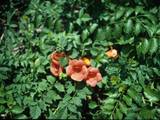
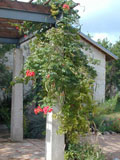
From the Image Gallery
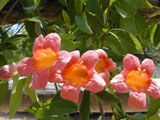
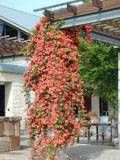
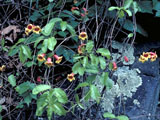
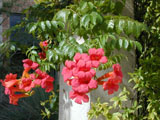
More Vines Questions
Blocking dust from a road in Sturgis MS
September 20, 2012 - Please let me know what Trees/shrubs will help block dust from dirt road.
view the full question and answer
Native plants for roadside in Gallatin TN
February 19, 2012 - What native plant would you suggest that we try to establish on 100 feet of road frontage which gets full afternoon sun? The soil is mostly clay, and it's on a rather sleep hill about 10 feet high. ...
view the full question and answer
Identification of vine-like plant.
November 13, 2010 - I have a an odd plant that I bought years ago. It's like a vine. It has hard rubbery like leaves they turn inward and they are green. First a cone like shape grows then the leaves grow. I would like ...
view the full question and answer
Is Poison ivy always rooted in the ground?
November 11, 2015 - Does Poison ivy on a tree always start at the ground and climb up the tree or can it start producing its vine and leaves by itself at the top of the tree or middle?
view the full question and answer
Groundcover for vineyard from Round Rock, TX
February 04, 2013 - I will be planting a vineyard in the Hill Country next spring. I am looking to maintain low-growing understory plants across the entire vineyard to maintain soil health, choosing plants that the leaf...
view the full question and answer
| Support the Wildflower Center by Donating Online or Becoming a Member today. |