Native Plants

Q. Who is Mr. Smarty Plants?
A: There are those who suspect Wildflower Center volunteers are the culpable and capable culprits. Yet, others think staff members play some, albeit small, role. You can torture us with your plant questions, but we will never reveal the Green Guru's secret identity.
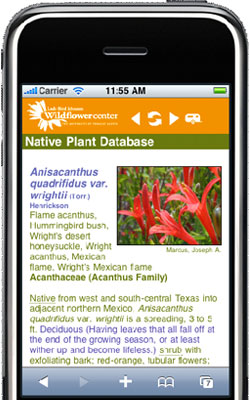
Did you know you can access the Native Plant Information Network with your web-enabled smartphone?

Ask Mr. Smarty Plants
Ask Mr. Smarty Plants is a free service provided by the staff and volunteers at the Lady Bird Johnson Wildflower Center.

rate this answer

Tuesday - March 06, 2012
From: Houston, TX
Region: Southwest
Topic: Invasive Plants, Shrubs, Trees
Title: Ligustrums planted last summer are doing poorly in Houston, TX.
Answered by: Jimmy Mills
QUESTION:
I planted large mature ligustrums trees (~ 8 ft) last summer and the leaves are turning yellow and falling off. Can you please tell me what the cause of this might be and what we can do to prevent the plant from further decay?ANSWER:
Let me start by stating that the mission of the Lady Bird Johnson Wildflower Center is to increase the sustainable use and conservation of native wildflowers, plants and landscapes. You may have Ligustrum japonicum which is an introduced species from Japan, and is considered an invasive species in Texas. This Nativw Plant Guide by the Houston Chapter of the Native Plant Society of Texas explains their Exotics Instead of Common Exotics (NICE) program. See page 24 for possible alternatives to Ligustrum in the Houston area.
When you say last summer, are you talking about the summer of 2011, one of the hottest summers on record? If so, Mr. Smarty Plants is thinking your Ligustrums are suffering from transplant shock. Summer is not a good time to transplant large trees/shrubs.
I’m including three links that explain transplant shock, and steps that can be taken to prevent it and treat it.
Clemson University
northscaping.com
gardeningknowhow.com
More Invasive Plants Questions
Care for indoor ivy from Carollton TX
January 26, 2012 - I have an indoor ivy that is on a pole. The pole is breaking, and I need to separate the ivy from the pole with the least amount of trauma to the plant. How should I do this? Thanks!
view the full question and answer
Possibility of camas being raised in Edmonton, Alberta
September 18, 2007 - I live in Edmonton, Alberta, and wish to find out how "Camassia (leichtlinii white) will fare in this zone.
view the full question and answer
Control of King Ranch Bluestem (Bothriochloa ischaemum)
November 21, 2007 - What is the best way to get rid of King Ranch Grass (an invasive plant) on my half acre property? I felt like mowing just encouraged more seed heads to pop up.
view the full question and answer
Kudzu for Ft. Lauderdale, FL
July 27, 2010 - I just inherited a piece of land and am very much interested in starting some kind of homeopathic herbs. Can you tell me about Kudzu and where I can purchase some of these seeds?
view the full question and answer
Fast growing, possibly invasive trees for South Carolina
July 12, 2007 - What fast growing trees would you suggest for South Carolina? We are heavy clay and the pecan trees we planted don't see to be too happy here. We are looking at the yellow poplar and the empress tre...
view the full question and answer
| Support the Wildflower Center by Donating Online or Becoming a Member today. |