Native Plants

Q. Who is Mr. Smarty Plants?
A: There are those who suspect Wildflower Center volunteers are the culpable and capable culprits. Yet, others think staff members play some, albeit small, role. You can torture us with your plant questions, but we will never reveal the Green Guru's secret identity.
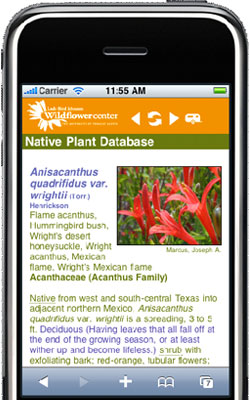
Did you know you can access the Native Plant Information Network with your web-enabled smartphone?

Ask Mr. Smarty Plants
Ask Mr. Smarty Plants is a free service provided by the staff and volunteers at the Lady Bird Johnson Wildflower Center.

rate this answer

Wednesday - January 18, 2012
From: Folsom, CA
Region: California
Topic: Planting, Shrubs, Trees
Title: Need tree suggestions for a long, narrow strip in Folsom, CA.
Answered by: Jimmy Mills
QUESTION:
I live in Folsom, Ca. I have a long strip (50') of planting area about 2.5' wide at the top of a retaining wall to the fence behind it. I would like to plant alternating (2) trees down this strip to block views of neighbors yards (maybe 12'-15' high). Can you tell me two types of trees that won't send roots through the fence or retaining wall?ANSWER:
Mr. Smarty Plants is having some difficulty visualizing the situation that you describe. How tall is the fence, and what type is it? It sounds as if you are hoping to the constrain the tree roots in a 2.5' wide space along the length of the wall. This is referred to by some people as a non-invasive root system.
People frequently ask about “taproot” trees thinking that the root grows straight down and will not interfere with sidewalks, driveways, and foundations. Some trees begin with a taproot, but as the system matures, it spread out in all directions in search of water and nutrients, and to provide a base of support to stabilize the tree. A tree that reaches a height of 20 feet can have a canopy at least that wide, and will have roots that spread out three to four times the width of the canopy. I am including links to Colorado State University Extension and Iowa State University Extension that explain this concept further.
As for the tree recommendations, I am going to introduce you to our Native Plant Database that will help you select trees for your situation. The Database contains 7,161 plants that are searchable by scientific name or common name.
There are several ways to use the Database, but we are going to start with the Recommended Species List. To do this, go to the Native Plant Data Base and scroll down to the Recommended Species List box. Clicking on the map will enlarge it so that you can click on Northern California. This will bring up a list of 286 commercially available native plant species suitable for planned landscapes in California. These aren’t all trees, so you need to go to the “Narrow Your Search” box on the right of the screen and make the following selections: select California under State, Tree under General Appearance, and Perennial under Lifespan. Check Sun under Light Requirement, and Dry under Soil Moisture (or the conditions that apply). Click on the Submit Narrow Your Search button and you will get a list of 13 native species from which to chose. Since trees may not be appropriate for your situation, you can go through the selections again, this time choosing Shrub under General Appearance. Click on the Narrow Your Search button, and now you have 32 native species. Clicking the Scientific name of each plant will bring up its NPIN page that gives the characteristics of the plant, its growth requirements, and in most cases, photos. You can get different lists by changing the Light requirement and Soil moisture selections.
Here is another link to Colorado State University Extension that has good information on tree selection.
For help closer to home, you might contact the folks at the Sacramento County office of University of California Cooperative Extension.
More Planting Questions
Non-blooming Tecoma stans in Fredericksburg, TX
June 30, 2008 - We have an esperanza plant purchased last year from Walmart and planted outside before winter. It flowered excellently last year. Just before winter we cut it back to about a foot. So far this summer ...
view the full question and answer
Adding Wildflowers to Corpus Christi
May 20, 2012 - I have a dry sandy yard, full sun in Corpus Christi with lot's of stickers mostly, want to transform to wildflowers. When should I plant, how should I prepare soil, should I dig out stickers? Which w...
view the full question and answer
need recommendation for small evergreen shrub in Katy, TX
September 14, 2015 - recommendation regarding small to mediun evergreen palnt in full sun in 2feet by8 feet area.
view the full question and answer
Puppy-proof plants in Denton TX
June 04, 2010 - I recently got a couple of puppies that stay outside in a fenced off area of the backyard. Of course, they love trying to dig under the fence and get out. I placed cement landscaping border stones alo...
view the full question and answer
Need suggestion for a replacement tree in Dallas, TX.
January 23, 2013 - We are going to have a 25' tall tree removed and ground out because every year squirrels chew the branches and make huge piles on the deck and into the pool. This continues for a good month 1.5. Hen...
view the full question and answer
| Support the Wildflower Center by Donating Online or Becoming a Member today. |