Native Plants

Q. Who is Mr. Smarty Plants?
A: There are those who suspect Wildflower Center volunteers are the culpable and capable culprits. Yet, others think staff members play some, albeit small, role. You can torture us with your plant questions, but we will never reveal the Green Guru's secret identity.

Did you know you can access the Native Plant Information Network with your web-enabled smartphone?

Ask Mr. Smarty Plants
Ask Mr. Smarty Plants is a free service provided by the staff and volunteers at the Lady Bird Johnson Wildflower Center.

rate this answer

Thursday - November 10, 2011
From: Austin, TX
Region: Southwest
Topic: Invasive Plants, Edible Plants, Herbs/Forbs, Shrubs
Title: Information on edible tubers of hog potato from Austin
Answered by: Barbara Medford
QUESTION:
I inquired a while back about hog potato or Hoffmannseggia glauca. You gave me some information on the plant but no information on when the plant produces the edible tubers. Also how long does it take to produce the tubers after the seed germinates? Thank you,ANSWER:
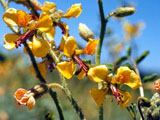
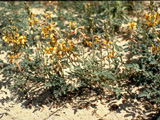
We found the previous answer on Hoffmannseggia glauca (Indian rushpea) to which you are apparently referring. We suspect the the reason we didn't give you this information the first time around is that it was not available in our research resources. We did find a couple more websites that talk about the edibility of the tuber (mostly, as indicated by the common name, by rooting pigs).
Here are two references that did not appear in the original answer that might give you some more information:
Southwestern Arizona Wildflowers
Kansas Wildflowers and Grasses - this may give us a clue as to why no one is much interested in studying this plant, as it is referred to as "an aggressive noxious weed." Since it is a member of the Fabaceae or pea family, it does propagate by seeds and is a perennial. The swollen tubers are part of the system that permits this plant to spread, so we are assuming if the plant in question has been germinated from seed, and not tubers, it would probably be a year or more before that plant was mature enough to begin manufacturing the tubers and expanding the area of the plant.

From the Image Gallery
More Edible Plants Questions
Fiber and dye plants at the Wildflower Center from Round Rock TX
May 24, 2012 - When I visited the Wildflower Center recently I noticed a garden labeled as containing fiber and dye plants, but the individual plants and their uses were not all labeled. I would be very interested ...
view the full question and answer
Pruning non-native peach in Austin, TX.
June 18, 2015 - I planted two five gallon Texas Star peach trees last February but didn't have the nerve to prune them back to knee height. After having been convinced that this is a good thing to do, I'd like to k...
view the full question and answer
Odor and flavor of oils in Mints as insect repellants
December 19, 2005 - I am trying to find information on "How does mint plants repel insects" It's for my grand daughter's science project. Any help will be appreciated.
Thank you
view the full question and answer
Huckleberries and blueberries from Vancouver WA
April 14, 2013 - Can you plant a blueberry next to a huckleberry?
view the full question and answer
List of plants native to the Abilene, Texas area
September 15, 2011 - Am looking for direction to a complete list of plants native to the Abilene, Taylor County, Texas area (trees, shrubs, grasses, cacti and other plants that grew here before cultivation, eradication or...
view the full question and answer
| Support the Wildflower Center by Donating Online or Becoming a Member today. |