Native Plants
Q. Who is Mr. Smarty Plants?
A: There are those who suspect Wildflower Center volunteers are the culpable and capable culprits. Yet, others think staff members play some, albeit small, role. You can torture us with your plant questions, but we will never reveal the Green Guru's secret identity.
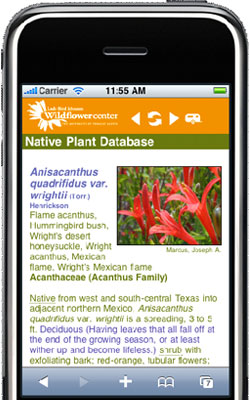
Did you know you can access the Native Plant Information Network with your web-enabled smartphone?

Ask Mr. Smarty Plants
Ask Mr. Smarty Plants is a free service provided by the staff and volunteers at the Lady Bird Johnson Wildflower Center.
rate this answer

Thursday - November 17, 2011
From: Norfolk, VA
Region: Mid-Atlantic
Topic: Plant Identification
Title: Identification of perennial with dark red/purple flowers
Answered by: Nan Hampton
QUESTION:
Need to identify a lovely perennial here in Norfolk, Virginia. It reseeds itself, spreads, and lingers into the late fall. It has rather thick, dark green, alternate spatulate leaves at the base with thin stalks of tiny lovely dark red/purple flowers which look like small beads. Total height is about 18 inches. The "beads" come off the main stalk in alternate arrangements with each bead occupying an end of a fine, hair-like "branch." It is very shallow rooted and the leaves and base are very tender and easily snapped. I was told it was "Jewels of the Nile," but it is not a hosta or the large blue "Jewel of the Nile." I have photos which I can forward if desired. Thank you!ANSWER:
Searching for your plant, I did a COMBINATION SEARCH in our Native Plant Database and selected "Virginia" from the Select State or Province option, "Herb" from Habit (general appearance), "September", "October" and "November" from Bloom Time and "Red" and "Purple" from Bloom Color. This resulted in 98 plants native to Virginia, but none of them appeared to match your description. You should try doing the search yourself to see if, perhaps, I missed it; but, I suspect that your plant is not a North American native. Since our expertise and focus here at the Lady Bird Johnson Wildflower Center is with North American native plants, we are not the best source for identifying cultivated non-native plants. If you visit our Plant Identification page, you will find links to several plant identification forums that will accept photos for identification. However, the best option would probably be to contact the Norfolk Master Gardener Association and/or the Norfolk Botanical Garden—sources closer to you that would have expertise in cultivated plants of your area.

More Plant Identification Questions
Care for Vauquelinia angustifolia (Chisos Rosewood)
June 08, 2008 - Hello, I have another question for you. A friend has given me a plant called "Chisos Rosewood" which they bought on a whim but decided they couldn't use. It's said to be evergreen. It's about...
view the full question and answer
Plant Identification from Ephrata PA
May 04, 2010 - I've come across a low plant with bright green leaves and a distinct burgundy on the leaf. I've been told it's called Throw Me Over The Fence, but I believe it must be called something else. I be...
view the full question and answer
Identification of plant with small lilac flowers in Laredo
May 14, 2013 - Need help identifying the following: small lilac flowers in a cluster with seed pods, unpleasant scent which can be up to 3 feet tall ..wild flower or weed? am interested if it attracts hummingbirds...
view the full question and answer
Differences between Ratibida columnifera and Ratibida peduncularis
June 03, 2010 - How do you tell the difference between Ratibida columnifera and Ratibida peduncularis. On NPIN columnifera has red and penduncularis is solid yellow, but I have seen pictures listed as columnifera tha...
view the full question and answer
Plant ID from Bracketville TX
June 23, 2010 - A volunteer plant, 3 feet. 4 to 5 Dark green leaves from a central point, diamond shaped very serrated leaves with dark spots within the the leave. Stem is reddish. flowers are pinkish, small and clus...
view the full question and answer
| Support the Wildflower Center by Donating Online or Becoming a Member today. |