Native Plants

Q. Who is Mr. Smarty Plants?
A: There are those who suspect Wildflower Center volunteers are the culpable and capable culprits. Yet, others think staff members play some, albeit small, role. You can torture us with your plant questions, but we will never reveal the Green Guru's secret identity.

Did you know you can access the Native Plant Information Network with your web-enabled smartphone?

Ask Mr. Smarty Plants
Ask Mr. Smarty Plants is a free service provided by the staff and volunteers at the Lady Bird Johnson Wildflower Center.

rate this answer

Wednesday - November 09, 2011
From: Fredericksburg, TX
Region: Southwest
Topic: Compost and Mulch, Diseases and Disorders, Grasses or Grass-like
Title: Native Grass is Falling Over
Answered by: Mike Tomme
QUESTION:
Hi Mr. Smarty Plants, I've tried to find this answer but am stumped as to the cause. We live in Fredericksburg, TX and have several different tall grasses, Yellow Indian grass, Little Bluestem, wire grass. Some have done very well this year. Others, especially the wire grass, have fallen over or lodged. They are growing, but aren't reaching for the sky like the others. All get the same amount of water, sun and no amendments. Several that are falling over are in the same bed as the ones that aren't. Can you tell me why? We water about 1" a week. Thank you very much!!ANSWER:
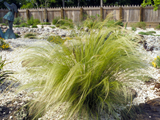
The Native Plant Database identifies three grasses that go by the name wiregrass; Aristida beyrichiana (Beyrich threeawn), Aristida stricta (Pineland threeawn) and Nassella tenuissima (Mexican feathergrass). The first two occur in the pine woodlands of the southeast United States and are not native to Texas, so Mr. Smarty Plants suspects you are talking about the third. This is a very widely used plant in central Texas landscapes.
It's always hard to guess what the problem is with a plant when you can't see it (and often when you can see it), but let's start with the basics. Here is what the Native Plant Database has to say:
"Growing Conditions
Water Use: Low
Light Requirement: Sun , Part Shade
Soil Moisture: Moist , Dry
Soil Description: Well-drained, acid or calcareous sands, loams, or clays.
Conditions Comments: Requires good drainage and cant take excessive moisture. Should not be watered heavily more than once a week. Goes dormant during drought and in winter. May rot under heavy mulch. Grows well in containers."
Usually, the problems with this plant result from too much water or poor drainage that can be exacerbated by heavy mulch. It doesn't sound like you are overwatering at one inch per week, but you might check to make sure your soil is drying out between waterings.
You will also note that the plant goes dormant during drought. During this past summer in central Texas lots of these plants around town fell over or otherwise went dormant.
Another possible explanation is that some plants are just less vigorous than others and you may have some that are simply predisposed to being small.
My advice right now is to keep up your watering schedule, make sure they are not too heavily mulched and see if the cooler weather brings some improvement.
From the Image Gallery
More Diseases and Disorders Questions
Yellow-orange fungus on Ash tree in Ohio
July 14, 2009 - Dear Mr. Smarty Plants, I have a large ash tree which started growing some yellowish orange fungus around the base this spring. With this fungus there are also black bugs with a orange marking near i...
view the full question and answer
Smarty Plants on lantana in Dallas
September 14, 2005 - For several years, the lantana plants in my backyard in Dallas grew and bloomed all Summer and Fall until the first real cold snap. I've loved having a native plant that didn't need constant care a...
view the full question and answer
Yellowing leaves on Mexican Plum in Salado, TX.
July 24, 2013 - I do live in Cental Texas (Salado) and I have the same problem with my Mexican Plum as the lady in Bellaire, TX. Mine was planted in June in a raised bed and receives sun all day long. Within the la...
view the full question and answer
Problems with Blackeyed Susans in Philadelphia
May 26, 2009 - For 8 years I successfully grew Black Eyed Susans in a fairly large area in my garden. For the last two years,almost immediately upon pushing through the ground they develop black spots and then appe...
view the full question and answer
Improving blooming on mock orange
March 03, 2008 - I have a now 6 yr. old mock orange shrub in the garden which has never bloomed, darn it. I have fed, not fed, mulched, not mulched, sheared, not sheared. What gives? Will it ever bloom, or shall I ...
view the full question and answer
| Support the Wildflower Center by Donating Online or Becoming a Member today. |