Native Plants

Q. Who is Mr. Smarty Plants?
A: There are those who suspect Wildflower Center volunteers are the culpable and capable culprits. Yet, others think staff members play some, albeit small, role. You can torture us with your plant questions, but we will never reveal the Green Guru's secret identity.

Did you know you can access the Native Plant Information Network with your web-enabled smartphone?

Ask Mr. Smarty Plants
Ask Mr. Smarty Plants is a free service provided by the staff and volunteers at the Lady Bird Johnson Wildflower Center.

rate this answer

Friday - August 05, 2011
From: Austin, TX
Region: Southwest
Topic: Diseases and Disorders, Trees
Title: Bulging trunks on post oak
Answered by: Nan Hampton and Eric Beckers
QUESTION:
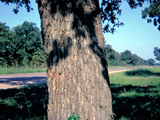
I have a huge post oak with a codominant trunk that is bulging between the two main trunks. The bulging is causing the trunks to spread apart, so one of the trunks is getting much too close to the house. We had an arborist look at the tree, and he said it was a very healthy tree, but the bulges are getting bigger. What is causing the bulges, and how do we stop it before they get bigger? We definitely want to keep both the house and the tree.ANSWER:
When I first read your question I thought about tree burls. As you can see in the article, the cause for this growth is unknown and removing them often leads to the death of the tree. Because of their unusual and often beautiful internal grain patterns, they are highly prized by woodworkers. Since this was the only possibility that I could think of, I thought it would be best to consult a tree expert, Eric Beckers of the Texas Forest Service. This is what Eric had to say:
"It may not be a burl. Codominant stems often push out bark and extra wood around their point of juncture and this could be what they are talking about. Either way, there aren't too many options of dealing with excessive tissues protruding into a man made structure. One or the other will probably have to give. Some folks modify the house and allow the tree to keep growing, while others opt to cut back on the intruding party. Actually, the house construction years earlier probably intruded on the post oak realm. They're lucky this construction sensitive species didn't fail earlier."
Utility companies have been known to use chemicals to reduce the growth rate of trees around power lines in order to increase the pruning rotational period. Here is an article with more information, Growth Retardants: A Promising Tool for Managing Urban Trees, from Purdue University Forestry & Natural Resources. Eric mentioned that he had talked with other foresters about growth retardants as a solution to your problem and none of them were very keen on them. However, you might want to discuss the possibility with an arborist. Eric suggested that you should probably call out 2 or 3 certified arborists to get a better feel for the options available to you, your house and the tree. You can go to TreesAreGood.com and plug in your zip code to narrow down a search for ISA certified arborists in your area.
From the Image Gallery
More Trees Questions
Transplanting redbud from field in Edmond, OK
March 30, 2009 - I want to transplant a small redbud from a field to my yard. The trunk diam is about 1.5" and the tree is about 4' tall. What is the best way to do this? Should I plant it in a pot first?
view the full question and answer
How close to plant Prunus carolinia for a privacy buffer in Montgomery, TX.
December 16, 2010 - I recently purchased some Prunus caroliniana trees for a privacy buffer between my neighbor and me. I have not yet planted them. They are in 25 gallon buckets and are about 10 feet tall now. How mu...
view the full question and answer
Should I plant a Beech Tree in Austin, TX
October 06, 2009 - I'm considering planting a beech tree but most of the gardeners I've talked to think it won't do well in central Texas. The main issue seems to be an inadequate dormancy period due to our mild wint...
view the full question and answer
Fertilizing oaks to produce acorns
January 16, 2012 - Will fertilizing oak trees help with acorn production?
view the full question and answer
Protection of Mountain Laurel from Pyralid or Genista moth caterpillars
May 28, 2006 - I have a Texas Mountain Laurel. Every year it is attacked by caterpillars. They form a bag for lack of a better word on the ends of the branches destroying the blooms for the following year. PLEASE...
view the full question and answer
| Support the Wildflower Center by Donating Online or Becoming a Member today. |