Native Plants
Q. Who is Mr. Smarty Plants?
A: There are those who suspect Wildflower Center volunteers are the culpable and capable culprits. Yet, others think staff members play some, albeit small, role. You can torture us with your plant questions, but we will never reveal the Green Guru's secret identity.
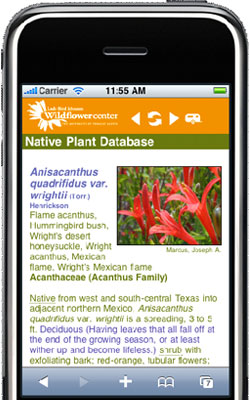
Did you know you can access the Native Plant Information Network with your web-enabled smartphone?

Ask Mr. Smarty Plants
Ask Mr. Smarty Plants is a free service provided by the staff and volunteers at the Lady Bird Johnson Wildflower Center.

rate this answer

Thursday - June 23, 2011
From: Newton, NJ
Region: Northeast
Topic: Plant Identification
Title: Plant identification of a trillium in New Jersey
Answered by: Nan Hampton
QUESTION:
I have several Trillium grown from one seed source. The plant looks like Trillium cuneatum, but unlike that plant, the stems of these plants -- which seed freely in my Northwest New Jersey garden -- lay on the ground so that the leaves appear to be flush with the soil. I was told this plant was Trillium alabamensis, but that does not appear to be a recognized name. Thoughts? Thank you so much -- I need the correct name for a book caption.ANSWER:
As well as doing a general "Google" search, I searched in the followed taxonomic databases for Trillium alabamensis:
This name couldn't be found in any of them. I don't know where your informant got that name but I don't believe it is a valid name for any Trillium species.
Next, I tried looking for other trilliums that might meet your description. I'm not sure where you got your seeds and if it was a source for native trilliums from your area, but I did find one native, Trillium sessile (Toadshade), that looks very similar to Trillium cuneatum (Little sweet betsy) but with very short stems. Here is a description of T. sessile and a description of T. cuneatum from eFloras.org. These descriptions aren't easy to get through, but T. sessile seems to be, essentially, a shorter, smaller version of T. cuneatum. Neither are seen to occur in New Jersey on the distribution maps on the eFloras site, but distribuion maps for both T. sessile and T. cuneatum in the USDA Plants Database show them appearing in states adjacent to New Jersey.
Your best bet for determining the identity of your short trillium, I think, is to contact someone with the New Jersey Native Plant Society.
More Plant Identification Questions
Is there an App for that?
June 05, 2012 - Do you have an app like leafsnap that my students can use to identify the plants around our school? I would like them to take a picture of the leaf of each plant with their iPads and have your data b...
view the full question and answer
Identification of low plant with like waterlily pad
May 04, 2008 - Mr. Smarty Plants, I have a low growing plant with leaves the shape of a waterlily pad, approx.1" growing all over my yard. I actually like them but would like to know the name of the plant.
Thank y...
view the full question and answer
Plant identification
December 15, 2008 - I am looking for the name of the plant that looks like the spider plant but can survive the cold weather of the northeast. It looks just like the indoor spider plant but it does not produce offshoots....
view the full question and answer
Wildflower in southeastern Pennsylvania
May 20, 2008 - I live in southeastern Pennsylvania and want to identify a wild flower that is common along small town and rural roads and highways. It is blooming now (Mid May), has a flower spike similar to a larks...
view the full question and answer
Plant identification in Mojave Desert
November 20, 2013 - I need help in identifying a shrub like plant that I found in SW Utah near Beaver Dam, UT (Which is near the Arizona/Nevada border). It is approximately 12 inches in height with profuse stems origina...
view the full question and answer
| Support the Wildflower Center by Donating Online or Becoming a Member today. |