Native Plants

Q. Who is Mr. Smarty Plants?
A: There are those who suspect Wildflower Center volunteers are the culpable and capable culprits. Yet, others think staff members play some, albeit small, role. You can torture us with your plant questions, but we will never reveal the Green Guru's secret identity.
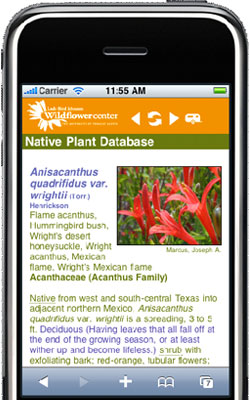
Did you know you can access the Native Plant Information Network with your web-enabled smartphone?

Ask Mr. Smarty Plants
Ask Mr. Smarty Plants is a free service provided by the staff and volunteers at the Lady Bird Johnson Wildflower Center.

rate this answer

Wednesday - May 18, 2011
From: Mason, OH
Region: Mid-Atlantic
Topic: Non-Natives
Title: Problems with non-native African violets from Mason OH
Answered by: Barbara Medford
QUESTION:
I have had 3 african violets for at least 4 weeks. I continue to water them and have moved their location. They continue to have wilted leaves. Are they done for or is there something I can do to get them healthy?ANSWER:
The African violet, botanical name Saintpaulia, is native to, well, Africa and is a tropicsl plant mostly grown as a house plant in this country. The Lady Bird Johnson Wildflower Center is dedicated to the growth, propagation and protection of plants native not only to North America but to the area in which those plants grow natively. Just about all houseplants are non-native tropicals that are able to handle the inhospitable conditions involved in growing indoors.
Since we have no personal experience with African violets and they will not, of course, appear in our Native Plant database, we would like to provide you with some sources for information on the plants that will surely help you more than we could.
Purdue University Coopertive Extension Service - African Violet Care
University of Rhode Island Horticulture Program - Caring for African Violets
African Violet Society of America - Basic Care
More Non-Natives Questions
Problems with non-native weeping willow from Hazlet NJ
July 03, 2013 - Leaves turning yellow on weeping willow planted in May. What causes this and how can I fix it? Mother's Day gift after SANDY uprooted huge tree.
view the full question and answer
Thorns on non-native orange trees in Greenwell Springs, LA
April 26, 2009 - Navel orange tree has thorns, why is this?
view the full question and answer
Repotting non-native Agave ghiesbreghtii from Spring TX
June 03, 2012 - I've recently purchased an Agave ghiesbreghtii, and will need to re-pot it soon.
I have some cactus soil mix as well as a few rocks to put in the bottom of its new pot. There seem to be roots comi...
view the full question and answer
Transplant shock for non-native Plumbago auriculata
May 19, 2008 - I planted some full plumbago plants that were in containers, in a partially shaded area, they had beautiful flowers when I purchased them, but have since lost them all and the plant is looking very wi...
view the full question and answer
Slow flowering wisteria
May 09, 2007 - We have a young wisteria growing on the side of the house. It began to flower this year for the first time. Whereas my neighbors' wisterias all bloomed in February, ours has only begun to bloom in mi...
view the full question and answer
| Support the Wildflower Center by Donating Online or Becoming a Member today. |