Native Plants

Q. Who is Mr. Smarty Plants?
A: There are those who suspect Wildflower Center volunteers are the culpable and capable culprits. Yet, others think staff members play some, albeit small, role. You can torture us with your plant questions, but we will never reveal the Green Guru's secret identity.

Did you know you can access the Native Plant Information Network with your web-enabled smartphone?

Ask Mr. Smarty Plants
Ask Mr. Smarty Plants is a free service provided by the staff and volunteers at the Lady Bird Johnson Wildflower Center.

rate this answer

Tuesday - February 01, 2011
From: Austin, TX
Region: Southwest
Topic: Shade Tolerant
Title: Non-Poisonous, Shade Tolerant Vine for Austin
Answered by: Mike Tomme
QUESTION:
Hello, I live in northwest Austin and have a very shady wood fence I would like to cover and was thinking about a vine. I have a toddler and a dog so anything poisonous is out of the question. I would like to plant something responsible and native. Thanks.ANSWER:
Here are a couple of ideas:
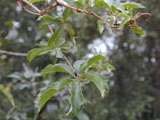
Parthenocissus heptaphylla (Sevenleaf creeper)
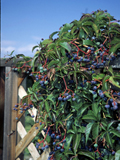
Parthenocissus quinquefolia (Virginia creeper).
Both of these plants are shade tolerant and will give some fall color (this will be less in the shade than it would if grown in the sun). Virginia Creeper will probably be a little faster growing and will be a better climber because the vines have adhesive tips which the Sevenleaf creeper lacks. The Sevenleaf creeper can be trained to climb, but will not do so as readily as Virginia creeper.
Now, as for being poisonous, the description of Virginia creeper in the link above contains the phrase "The berries of Virginia Creeper can be harmful if ingested." North Carolina State University has a poisonous plants database with a page on Virginia creeper that contains this: "HIGHLY TOXIC, MAY BE FATAL IF EATEN!"
However, neither species shows up on these three databases that I checked:
ASPCA Toxic and Non-Toxic Plant List - Dogs
University of Pennsylvania Poisonous Plants.
It is odd that one site gives such a dire warning while others are completely silent. All Mr. Smarty Plants can say is - it's not clear. If this is a big concern for you, the Sevenleaf creeper may be a better choice for you.
More Shade Tolerant Questions
Shade tolerant plant for Rodeo, California
November 02, 2008 - I live in Rodeo, California and I need to know what is a good green plant I can get to place in a shady area
view the full question and answer
Shade tree with non-aggressive roots for next to pool in The Woodlands TX
April 26, 2011 - Hi Mr. Smarty Plants.
We live in Spring, TX and are looking for a full-sun shade tree to plant in a large planter (about 6'x6') next to our pool. We want the tree to provide shade for our full a...
view the full question and answer
Plants for shade in Pennsylvania
September 13, 2008 - i would like to plant a small area in my rear yard, that is full shade in the summer (when the trees are full with leaves) and part shade in early spring. i live on a state park - there are plenty of...
view the full question and answer
Privacy screening from Phoenix AZ
April 14, 2013 - I live in the center of Phoenix, Az. On the eastern side of my house we have some 2 story condos next door. The width of the side yard is about 12'-15' and it gets lots of shade. I also have my powe...
view the full question and answer
Plants for shade native to New York
June 13, 2006 - I am gradually trying to convert my garden to all natives. I am working in a shaded area under a maple tree. Are there any varieties of epimediums/barrenwort or hellebores that are native to the nor...
view the full question and answer
| Support the Wildflower Center by Donating Online or Becoming a Member today. |