Native Plants

Q. Who is Mr. Smarty Plants?
A: There are those who suspect Wildflower Center volunteers are the culpable and capable culprits. Yet, others think staff members play some, albeit small, role. You can torture us with your plant questions, but we will never reveal the Green Guru's secret identity.

Did you know you can access the Native Plant Information Network with your web-enabled smartphone?

Ask Mr. Smarty Plants
Ask Mr. Smarty Plants is a free service provided by the staff and volunteers at the Lady Bird Johnson Wildflower Center.

rate this answer

Friday - January 07, 2011
From: Ashford, CT
Region: Northeast
Topic: Trees
Title: Windthrow Resistant Trees for Northeast Connecticut
Answered by: Mike Tomme
QUESTION:
We live in northeast CT, and prefer to plant native trees. Many people here do not want trees around their homes, despite the benefits of shade and shelter they provide, because they are afraid of windthrow damaging their homes. Which native trees are least likely to be vulnerable to being blown over? We have several high water table soils, but most are dry glacial till.ANSWER:
Mr. Smarty Plants worked a crossword puzzle recently where one of the clues read, "Strong as an _ _ _." Let's see, "ox?" Nope, not enough letters. "Acre of garlic?" Nope, too many letters. Wait, I've got it - Quercus.
No type of tree is going to be completely immune to windthrow, but the oaks did not come by their reputation for strength by accident. If any tree is going to stand up to a high wind, my money is on an oak.
Here are nine species of oak pulled from the native plant database which the USDA identifies as native to Windham county in northeast Connecticut:
Quercus bicolor (Swamp white oak)
Quercus coccinea (Scarlet oak)
Quercus rubra (Northern red oak)
Quercus rubra var. ambigua (Northern red oak)
From this list, you can go into the database (click on Plant Database in the upper right hand corner of this page) and look up each plant. You can then make your selection(s) based on your taste and the specific conditions of your site.
Here are a couple of pictures from the species listed above. These pictures are not intended to recommend these species, they're just pretty.
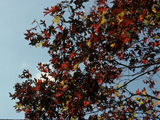
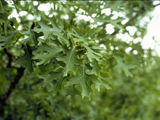
More Trees Questions
Transplant rootbound tree now from Kerrville TX
June 10, 2012 - I purchased a Blanco Crabapple tree. Should I plant it now or wait until Fall? (It is currently rootbound.)
Second question: Our Mountain Laurel has a dead trunk and one trunk has already died. I c...
view the full question and answer
Tree for caliche soil in Cochise County, Arizona
August 15, 2012 - What trees will thrive in areas of moderate caliche soil in southeast Arizona? My property is at 4,200 feet of elevation. Thanks for your help
view the full question and answer
What are the cone shaped evergreens around Pilot Point, TX?
January 26, 2016 - What are the cone shaped evergreens around Pilot Point, Texas called? They are dark green with spiky leaves and rough bark. I have a row planted as a windscreen and want to transplant a couple from a ...
view the full question and answer
Rocky Mountain Juniper Grazed by Deer
April 29, 2013 - I have four Colorado red cedar (Juniperus scopulorum). The deer have eaten from their height down. Now these narrow top to bottom evergreens have only tops left. Will the bottom fill in if I protect t...
view the full question and answer
Evergreen trees for California that are non-toxic for dogs
February 19, 2014 - Hi,
we live in California, San Bernardino County and would like to know what evergreen trees are safe to plant in our backyard with 2 little dogs being around. I did quite some search online but ever...
view the full question and answer
| Support the Wildflower Center by Donating Online or Becoming a Member today. |