Native Plants

Q. Who is Mr. Smarty Plants?
A: There are those who suspect Wildflower Center volunteers are the culpable and capable culprits. Yet, others think staff members play some, albeit small, role. You can torture us with your plant questions, but we will never reveal the Green Guru's secret identity.
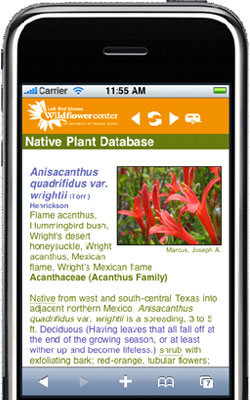
Did you know you can access the Native Plant Information Network with your web-enabled smartphone?
Ask Mr. Smarty Plants
Ask Mr. Smarty Plants is a free service provided by the staff and volunteers at the Lady Bird Johnson Wildflower Center.

rate this answer

Monday - November 29, 2010
From: Unknown city, CA
Region: California
Topic: Trees
Title: Are red berries of modesto ash toxic to dogs
Answered by: Nan Hampton
QUESTION:
Are the red berries that come off the modesto ash tree poisonous to dogs if they eat them?ANSWER:
Modesto ash, a cultivar of Fraxinus velutina (Arizona ash), does not appear on any of the following toxic plant databases that I checked:
ASPCA's Toxic and Non-Toxic Plant List – Dogs
Poisonous Plants of North Carolina
Cornell University Plants Poisonous to Livestock
University of Pennsylvania Poisonous Plants
Canadian Poisonous Plants Information System
However, I think you may have misidentified your tree. The fruit/seeds of Fraxinus velutina are NOT red berries. Their seeds are contained in winged structures called samaras, very much like maple seeds. You can see the seeds of Fraxinus velutina on the USDA Plants Database, as well as the Vascular Plants of the Gila Wilderness and the Southwest Environmental Information Network databases.
There are, however, several mountain ash trees (Sorbus sp.) that do have red berries. I suspect that one of these is the tree that you have. There are three native species of Sorbus that occur in California plus a non-native European one.
Sorbus californica (California mountain ash) and here are photos
Sorbus scopulina (Cascade mountain-ash)
Sorbus sitchensis (Sitka mountain-ash) and here are photos
Sorbus aucuparia (European mountain ash
None of the Sorbus species occurs on the toxic plant databases listed above. The berries from the European mountain ash, also known as the rowan tree, has been used historically for medicinal purposes and to make jelly and chutney.
If your tree isn't one of the Sorbus species above, you should try to get a correct identification of it. Visit Mr. Smarty Plants' Plant Identification page to find forums that will help you identify your tree if you provide them with photographs. Once you have its correct identification you can compare its name to those in the above lists. Your best bet is to use the botanical name for comparison in the the toxic plant databases since it less likely to be variable than the common name.


More Trees Questions
Small native evergreen tree for Long Island, NY
October 06, 2008 - Hi, I am looking for an evergreen tree to plant on Long Island NY. I plan on planting it in my front yard. At maturity to about 10-15ft about 5 ft wide. Not sure about soil, the area gets good AM sun ...
view the full question and answer
Canadian Marine West Coast Plants
December 15, 2011 - What type of plants are found in the Canadian marine west coast climate?
view the full question and answer
Advice on planting Korean dogwood (Cornus kousa) in Vancouver, BC
October 26, 2007 - I live in the Vancouver, BC - Pacific Northwest area and the front of our yard faces south to southwest. If I were to plant a tree other than an evergreen, would the Korean Dogwood thrive in this are...
view the full question and answer
Problem with unknown tree in Austin, Texas
July 23, 2013 - Have recently moved to Austin, Texas and have a tree in my backyard that has been dropping leaves and one major branch appears to be dead. That branch has hard rust colored sap circles (about penny si...
view the full question and answer
Fast-growing evergreens for privacy in Center, TX
March 30, 2010 - I live in East Texas and am looking for a fast growing evergreen for a privacy screen around my backyard. The area gets partial sun and the soil has a lot of clay in it.
view the full question and answer
| Support the Wildflower Center by Donating Online or Becoming a Member today. |