Native Plants

Q. Who is Mr. Smarty Plants?
A: There are those who suspect Wildflower Center volunteers are the culpable and capable culprits. Yet, others think staff members play some, albeit small, role. You can torture us with your plant questions, but we will never reveal the Green Guru's secret identity.

Did you know you can access the Native Plant Information Network with your web-enabled smartphone?

Ask Mr. Smarty Plants
Ask Mr. Smarty Plants is a free service provided by the staff and volunteers at the Lady Bird Johnson Wildflower Center.

rate this answer

Sunday - August 08, 2010
From: Austin, TX
Region: Southwest
Topic: Planting, Transplants, Shrubs
Title: Sumacs under live oaks dying in Austin
Answered by: Barbara Medford
QUESTION:
Converted my yard to native plants last fall. All of the fragrant and evergreen sumacs are dying off one by one - they have never thrived. I ensure they get a good soaking at least once a week. I was warned not to fertilize them or it will make them deer fodder. They are placed as understory for our live oaks and mulched with a couple inches of oak leaf/hardwood mulch. What can I do to save the few that are left?ANSWER:
Can we assume that the sumacs were planted when you did your conversion to native plants? If so, they have not been in the ground very long, and could still be suffering from transplant shock. We always check growing conditions on the page in our database for plants that are not doing well, and ask ourselves "Is this a plant in the wrong place, or the wrong plant for the place or was it planted at the wrong time?" According to this USDA Plant Profile for Rhus aromatica (fragrant sumac) it is not native to Travis County, but does grow in some counties to the north and east. However, according to this USDA Plant Profile, Rhus virens (evergreen sumac) is native to Travis County and several counties in the vicinity. Both require sun (6 or more hours of sun a day) or part shade (2 to 6 hours of sun), and tend to develop into thickets in open fields in the wild. Since they both are native to this area, we can assume they are in the right place in terms of soil, climate and rainfall.
So, what's left? You say they were planted as understory trees to live oaks. There is a lot being said now about the allelopathy of oaks; that is, emitting substances that discourage competition from other plants. These substances can be present in fallen leaves, roots, and bark. If the oak trees were already well-established, it just may be that there is not room in your space for both, and the oak trees are winning. Perhaps even the amount of water they are getting is inappropriate, as the growing conditions for both include low water use, dry soil, and tolerance of drouth.
If you have seen no insects or signs of disease on the sumacs, and they are supposed to be very resistant to both, we can only assume that the environment is wrong, including being planted beneath oak trees and mulched with oak leaves. How to help the remaining ones survive? You could try limbing up the live oaks to create more sunlight, cutting down on the watering, and raking away the oak leaf mulch. Will those work? Sorry, we simply don't know.
We want to caution you about limbing up or pruning your live oaks. From the Texas Oak Wilt Information Partnership comes these precautions about pruning live oaks, which are being devastated in Central Texas by Oak Wilt.
"All wounding of oaks (including pruning) should be avoided from February through June. The least hazardous periods for pruning are during the coldest days in midwinter and extended hot periods in mid- to late summer. Regardless of season, all pruning cuts or other wounds to oak trees, including freshly-cut stumps and damaged surface roots, should be treated immediately with a wound or latex paint to prevent exposure to contaminated insect vectors."
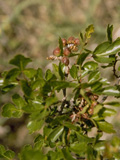
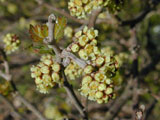
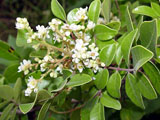
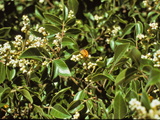
From our Native Plant Image Gallery:
More Shrubs Questions
No Berries on Possumhaw from Victoria, TX
November 08, 2010 - I bought a Possumhaw about 4 years ago because I love red berry plants. So you can realize my disappointment in this very healthy looking green tree that refuses to give me any red berries. What is wr...
view the full question and answer
Pride of Barbados seed for Ft. Worth TX
February 07, 2013 - When can you plant the Pride of Barbados plant seeds and how to go about it in Fort Worth Texas?
view the full question and answer
Plants for area around pool in Plano, Texas
October 13, 2009 - I just built an in ground pool in Plano, Texas and now want to landscape around it on my own. I am curious what plants/shrubs you recommend. There will be plants/shrubs on three sides of the pool. ...
view the full question and answer
Privacy screen from Temecula CA
May 04, 2013 - I live in Temecula and need a fast growing tree by our pool that is good to block neighbors house.
view the full question and answer
Trimming of Pineapple Sage and Salvia Greggii
October 07, 2007 - I live in Central Austin. My question is: When is the
best time to trim back Pineapple Sage and Salvia Gregii? How far back should these plants be trimmed?
view the full question and answer
| Support the Wildflower Center by Donating Online or Becoming a Member today. |