Native Plants

Q. Who is Mr. Smarty Plants?
A: There are those who suspect Wildflower Center volunteers are the culpable and capable culprits. Yet, others think staff members play some, albeit small, role. You can torture us with your plant questions, but we will never reveal the Green Guru's secret identity.

Did you know you can access the Native Plant Information Network with your web-enabled smartphone?

Ask Mr. Smarty Plants
Ask Mr. Smarty Plants is a free service provided by the staff and volunteers at the Lady Bird Johnson Wildflower Center.

rate this answer

Sunday - June 27, 2010
From: Fair Oaks Ranch, TX
Region: Southwest
Topic: Diseases and Disorders, Trees
Title: Possible freeze damage to Texas Persimmon in Fair Oaks Ranch TX
Answered by: Barbara Medford
QUESTION:
I have a Texas Persimmon tree that is in a green belt. It has leafed out and flowered for the eight years we have lived here. This year it leafed out then the leaves turned brown and dropped. The top appears dead. New growth is coming from the trunk near the soil. Should I cut the top off? Is it going to survive? We are at the end of a 2-3 year drought.ANSWER:
According to this USDA Plant Profile, Diospyros texana (Texas persimmon) is native to your area, regardless of which of the three counties you live in, Bexar, Comal or Kendall. We would also think that in USDA Hardiness Zone 8b, there should not have been freeze damage to it. However, we did have a most unusual winter all over Texas, and that is the most logical answer to your question we can come up with.
Try the thumbnail test on the bark of the tree; scrape off a very thin sliver of the bark, and see if there is a thin layer of green beneath that. Start up high on the dead part, and work down toward the roots. If and when you come to an underlayer of green, you can trim the tree off there. We would not, however, recommend you do that until the weather is cooler. Give the tree regular watering and don't fertilize, a tree under stress should never be fertilized. Also, don't trim off the new growth down below-that is probably suckers, but at this point the leaves on those suckers (which share a root with the tree) are the only sources of nutrition for the plant. When Fall comes and you can assess the situation, you can decide if you want a multi-trunk Texas persimmon or if you want to dig it out and start over.
From our Native Plant Image Gallery:
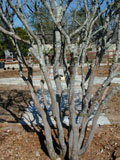
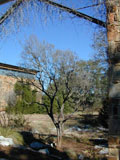
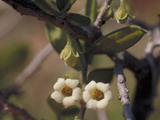
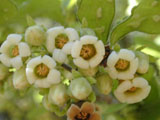
More Trees Questions
Shoots sprouting around base of liveoak tree
April 18, 2008 - I have a Live Oak that was planted in my yard about 15 years ago. In the last several years, small shoots have been sprouting up around the tree base, are getting more dense and spreading into the gr...
view the full question and answer
Life expectancy for Carolina buckthorn (Frangula caroliniana)
February 25, 2008 - Someone recently told me that Carolina buckthorn only lives 4-5 years and I'm wondering if that is true. I had a nice one (on Blackland) that died suddenly in its fourth or fifth year, during the dr...
view the full question and answer
Project on natives in Connecticut from Chino CA
April 13, 2010 - Hi Mr. Smarty Plants,
My 10 yr. old daughter is doing a project on Ct., and would like to know what the most common plants, trees and flowers are found in this state. A few of each would be a great ...
view the full question and answer
Problems with Eastern hemlock in Greenville SC
July 02, 2009 - Dear Mr. Smarty Plants,
I have a beautiful, young, 5 and a half foot tall Eastern Hemlock. I purchased and planted it two years ago in the fall. It has been doing very well all this spring. And ne...
view the full question and answer
Time to Plant Trees and Shrubs in the Dallas Area
February 13, 2015 - Is it OK to plant evergreen shrubs-trees in January or February in the Dallas, Texas area?
view the full question and answer
| Support the Wildflower Center by Donating Online or Becoming a Member today. |