Native Plants

Q. Who is Mr. Smarty Plants?
A: There are those who suspect Wildflower Center volunteers are the culpable and capable culprits. Yet, others think staff members play some, albeit small, role. You can torture us with your plant questions, but we will never reveal the Green Guru's secret identity.

Did you know you can access the Native Plant Information Network with your web-enabled smartphone?

Ask Mr. Smarty Plants
Ask Mr. Smarty Plants is a free service provided by the staff and volunteers at the Lady Bird Johnson Wildflower Center.

rate this answer

Wednesday - June 02, 2010
From: Wharton, TX
Region: Southwest
Topic: Shrubs
Title: Evergreen shrubs for foundation plants
Answered by: Nan Hampton
QUESTION:
Can you recommend any evergreen shrubs that would work as foundation plants in front of windows, so preferably below 4' tall? I would love a native plant, and of course anything for the birds and bees is given preference. Morning and noon sun, afternoon shade, deep soil, moderate alkalinity. THANKS!ANSWER:
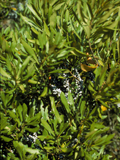
South Texas doesn't have a large number of evergreen shrubs and certainly fewer of them that are less than 4 feet tall. Your best bet for an evergreen shrub less than four feet tall is Morella cerifera (wax myrtle). There are dwarf varieties that have a maximum height of 4 to 5 feet. They will grow in sun, part shade or shade and in a variety of soils. Birds love the berries that grow on the female plants.
Here are three more possibilities:
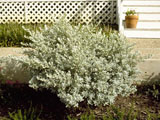
Leucophyllum frutescens (cenizo) can be gently pruned to stay below 4 feet.
Malpighia glabra (wild crapemyrtle) The winters in Wharton may be mild enough for this plant to retain its leaves through the season. It grows 3 to 6 feet high and its fruits are attractive to birds.
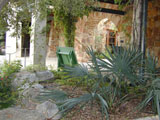
Sabal minor (dwarf palmetto) grows to 5 feet and has berries that are attractive to birds.
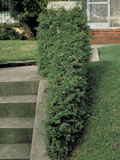
Here are photos from our Image Gallery:
More Shrubs Questions
Stress in potted Tif blueberry plants
August 15, 2008 - Recently purchased Tif Blue Blueberry plants (about 3 ft tall)are showing signs of stress. They are in 10 gallon pots. Should they be transplanted? Medium? Fertilizer? Location? Trimming?
view the full question and answer
Failure to thrive of Actaea simplex in Washington State
September 07, 2008 - I have a Actaea simplex 'Hillside Black Beauty' that I planted in mid August 2007 in a partial, almost full shade spot. This year it came back , but the foliage is brown with dark and light green a...
view the full question and answer
Aromatic sumac in Travis County
August 14, 2010 -
This is an answer to article in today's, August 14, newspaper. I assume that aromatic sumac is native to Travis county because I have it all over my property. It turns bright red in the fall adding...
view the full question and answer
Plants wilting too quickly in Toledo OH
May 27, 2012 - The garden I have had recent issues with plants wilting all too quickly. I would like to know what types of plants would be hearty for the climate in Toledo, Ohio. I have a partly sunny front yard and...
view the full question and answer
Narrow, evergreen shrub for privacy
December 28, 2008 - I live in San Antonio and my backyard is all driveway except for a 2-3' space in front of a 6 ft chain fence. I'd like to find an evergreen narrow shrub for privacy. Would Nandina be a good choice?...
view the full question and answer
| Support the Wildflower Center by Donating Online or Becoming a Member today. |