Native Plants

Q. Who is Mr. Smarty Plants?
A: There are those who suspect Wildflower Center volunteers are the culpable and capable culprits. Yet, others think staff members play some, albeit small, role. You can torture us with your plant questions, but we will never reveal the Green Guru's secret identity.

Did you know you can access the Native Plant Information Network with your web-enabled smartphone?

Ask Mr. Smarty Plants
Ask Mr. Smarty Plants is a free service provided by the staff and volunteers at the Lady Bird Johnson Wildflower Center.

rate this answer

Monday - May 17, 2010
From: Jacksonville, FL
Region: Southeast
Topic: Seed and Plant Sources
Title: Trying to find a plant called sheepshire
Answered by: Nan Hampton
QUESTION:
Hey there Mr. Smarty Plants, just one question. As a child in east Tennessee, we picked plants called sheepshire that looked like small clover leafs and had small yellow blooms. One could chew these leaves and they had a bitter-like taste. Is this true sheepshire or something else? Thanks.ANSWER:
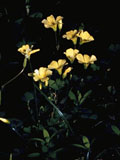
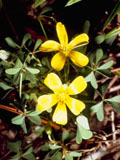
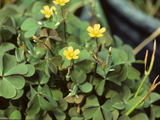
I think you must mean woodsorrel, Oxalis spp. The plants of this genus have clover-like leaves and a sour taste due to the oxalic acid that they contain. Here are four species of Oxalis with yellow flowers that are native to Tennessee:
Oxalis dillenii (slender yellow woodsorrel)
Oxalis grandis (great yellow woodsorrel)
Oxalis priceae (tufted yellow woodsorrel)
Oxalis stricta (common yellow oxalis)
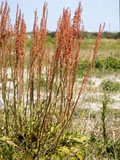
There is another plant called sheep's sorrel (sort of close to sheepshire), Rumex acetosella, a native of Europe, and a native one, Rumex hastatulus (heartwing sorrel), that I remember as a child in East Texas chewing on the stem and that we called the plant "sourweed". Here's an article about both Oxalis and Rumex.
Delena Tull in Edible and Useful Plants of Texas and the Southwest says, "Rumex hastatulus and R. acetosella, both commonly called sheep sorrel, have a pickle-sour flavor similar to that of Oxalis."
Oxalic acid is the compound in both Oxalis and Rumex that causes the sour flavor. In small portions it is harmless but large amounts can be toxic. Rumex spp. and Oxalis spp. can be toxic, but only if large quantities are consumed. Also, Rumex spp. can be toxic to livestock in large quantities.
So, what is true sheepshire? I don't really know. In the references I found it sounded as if they were describing either Oxalis sp. or Rumex sp. It seems to be a term that refers to sour-tasting weeds that you chew in the spring.
Here are photos from our Image Gallery:


More Seed and Plant Sources Questions
Source for trees from Burnet TX
August 19, 2012 - I am desperately searching the central Texas area for Pistacia Mexicana male and female trees to buy. I would like about four, maybe more. I live in the Killeen-Lampasas area and have been to seve...
view the full question and answer
Location of Taxus baccata
March 30, 2011 - Where in the USA may I purchase taxus baccata? I can't find them anywhere on the internet or at local nurseries. I need about 125! So, saplings would be preferred even though they are slow growing...
view the full question and answer
Replacing bermudagrass with buffalograss in San Antonio
October 28, 2009 - We inherited a back yard full of weeds when we bought a fixer-upper a couple of years back in San Antonio, TX. Since we moved in, some "native" bermuda started growing in the yard. I think the "nat...
view the full question and answer
Purchase sources of Buffalograss from Corpus Christi TX
March 17, 2012 - I've heard a lot of good things about Buffalograss, but no one in my area seems to carry it. One grower actually told me it didn't grow well here and recommended St. Augustine Floratam instead. Is ...
view the full question and answer
Will Copper Canyon Daisy be at the Plant Sale from Georgetown TX
March 21, 2011 - Can you find out if Copper Canyon Daisy will be sold at the plant sale? I'm having trouble finding it in any of your databases. The scientific name is Asteraceae Tagetes lemmonii. It's a shrubby ...
view the full question and answer
| Support the Wildflower Center by Donating Online or Becoming a Member today. |