Native Plants

Q. Who is Mr. Smarty Plants?
A: There are those who suspect Wildflower Center volunteers are the culpable and capable culprits. Yet, others think staff members play some, albeit small, role. You can torture us with your plant questions, but we will never reveal the Green Guru's secret identity.

Did you know you can access the Native Plant Information Network with your web-enabled smartphone?

Ask Mr. Smarty Plants
Ask Mr. Smarty Plants is a free service provided by the staff and volunteers at the Lady Bird Johnson Wildflower Center.

rate this answer

Tuesday - April 13, 2010
From: Varna, IL
Region: Midwest
Topic: Wildflowers
Title: Eliminating Claytonia virginica in Varna IL
Answered by: Barbara Medford
QUESTION:
How do I get rid of or control Claytonia virginica? It is starting to take over my lawn.ANSWER:
This is a toughie, because I was unable to find any negative comments on Claytonia virginica (Virginia springbeauty), or ways to get rid of it. According to this USDA Plant Profile, it is native to just about all of Illinois, including Marshall County. You are in USDA Hardiness Zone 5a, which is well within the tolerance of Spring Beauty, hardy from Zones 2 to 9. We even have some growing in Travis County, where the Wildflower Center is located, but Central Texas is really not what I would call a cool, moist woodland. We found this site from Illinois Wildflowers Spring Beauty, which, again, had nothing but nice things to say about the plant, which grows from small potato-like corms. Dave's Garden, a garden forum, also had mostly positive comments on Claytonia virginica.
We really can't even recommend any sort or herbicide, because the use of it would threaten other plants around the ones you want to get rid of, but not put Spring Beauty into any particular danger because it can regrow from those corms in the ground. According to our page on this plant in our Native Plant Database: "Plant disappears from above ground shortly after the seed capsules have ripened but does not leave a large gap in the garden." Speaking from very hot and dry Texas, we would think it would be lovely to have flowers beginning to bloom in the depths of Winter, and then disappearing until next year.
In view of the way the plant propagates itself, we would recommend first that you mow the lawn pretty low while these flowers are blooming, both preventing the re-seeding and also denying the nourishment of the leaves to the corms below ground. Second, if you don't want it in your flower beds, digging out that corm, which is about 3" deep, and continuing to do so until it gives up and starves is about the best bet.
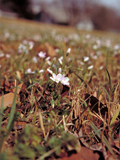
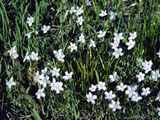
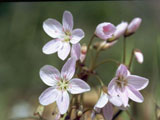
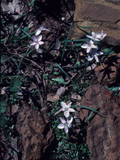
From our Native Plant Image Gallery:
More Wildflowers Questions
Hardiness of bluebonnet seeds under water and white bluebonnets
April 30, 2007 - I was trying to find out more about the hardiness of bluebonnets. We own a lot on Lake Travis near Spicewood Texas. As you are probably aware, the lake was very low this spring due to a drought that ...
view the full question and answer
Monarda species seed for heirloom gardens in Wales
June 15, 2012 - Hello. I am trying to obtain seeds for the following Monarda species: - barletti, lindheimeri, russeliana, and viridissima. Our address is Wales, United Kingdom and we are hoping to obtain the full c...
view the full question and answer
Instructions on making wildflower seed balls
September 20, 2007 - About 2 years ago I visited the LBJ Wildflower Center and picked up a sheet that described how to make wildflower seed mud balls. I've lost the sheet and can't find the directions on your site. Ca...
view the full question and answer
Spanish name for bluebonnet
May 14, 2008 - What is the Spanish name for bluebonnet? They were in Texas before any other Europeans and must have named the flower. I cannot find it anywhere.
view the full question and answer
Guidelines for planting native wildflowers on roadside
November 17, 2005 - My 4th grade Girl Scout troop has chosen to plant bluebonnets and other wild flowers along TX Hwy 114 in Southlake as their project for their Bronze Award. Do you have a guideline that you follow w...
view the full question and answer
| Support the Wildflower Center by Donating Online or Becoming a Member today. |