Native Plants
Q. Who is Mr. Smarty Plants?
A: There are those who suspect Wildflower Center volunteers are the culpable and capable culprits. Yet, others think staff members play some, albeit small, role. You can torture us with your plant questions, but we will never reveal the Green Guru's secret identity.
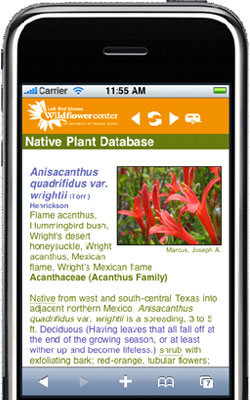
Did you know you can access the Native Plant Information Network with your web-enabled smartphone?
Ask Mr. Smarty Plants
Ask Mr. Smarty Plants is a free service provided by the staff and volunteers at the Lady Bird Johnson Wildflower Center.

rate this answer

Wednesday - January 20, 2010
From: Las Vegas, NV
Region: Southwest
Topic: Trees
Title: Trees that aren't poisonous or don't have poisonous berries for dogs
Answered by: Nan Hampton
QUESTION:
What trees are not poisonous or have poison berries for dogs?ANSWER:
It is easier to make a list of trees that ARE poisonous or that HAVE poisonous berries than it is to find non-toxic ones since the non-toxic ones prevail. I suspect you are looking for a tree to plant in your yard that won't be harmful to your dog. If that is so, I suggest you go to our Nevada Recommended species to find trees that are native to Nevada that are recommended for landscaping and are commercially available. After you've found ones that you like, you can check them against several poisonous plant databases such as:
Poisonous Plants of North Carolina, Cornell University's Plants Poisonous to Livestock, the Canadian Poisonous Plants Information System, the University of Pennsylvania's Poisonous Plants, Toxic Plants from University of California-Davis and Toxic and Non-Toxic Plant List—Dogs from the ASPCA.
For instance, if you like Abies concolor (white fir), you will find that it doesn't appear on any of the toxic plant lists above. Actaea rubra (red baneberry), however, is on the Poisonous Plants of North Carolina database and Cornell's Plants Poisonous to Livestock, but not any of the others and it appears to be mildly poisonous. Prunus virginiana (chokecherry) (or, at least Prunus sp., which includes peaches, plums, apricots and cherries) appears on all the above lists and is characterized as having major toxicity. So, the lesson here is that you probably should check more than one poisonous plants database. Not finding a plant in one of the databases doesn't necessarily mean it has no toxic qualities, but it makes it less likely that it is seriously poisonous. However, finding a plant in all, or the majority, of the above, databases is a pretty good indication that the plant is seriously toxic and shouldn't be where it can be accessed by your pets or small, unsupervised children.
(Please note that the ASPCA's list is arranged by common names which are quite variable and therefore not easy to search. The scientific names are there, although not as easily searched in the ASPCA's list, but are the most reliable name to use to find a plant in any database.)
More Trees Questions
Replacing Drought-Stricken Cedars
January 16, 2012 - Hello, I live in Williamson County on a couple acres. We have several dead cedars as a result of drought; we're reluctant to cut them down because many of them provide a friendly barrier between us...
view the full question and answer
What eats American holly bushes in winter?
January 24, 2010 - I live in Marlborough, MA and I was shoveling snow on January 19th and noticed how beautiful my Holly bush was covered in red berries against the new fallen snow. My husband said to me this morning (...
view the full question and answer
Source for Pyrus ioensis var. Texana
July 09, 2015 - Any idea where I can find Pyrus (now Malus) ioensis var. texana for sale around the Austin area?
view the full question and answer
Thuja arborvitae not thriving in Austin
November 04, 2010 - I planted 5 giant thuja arborvitae two years ago. They have grown six inches and aren't doing that well. I live in Austin Texas and it was a hot summer. I water them 2x a week, now 1x a week. They a...
view the full question and answer
Native tree for San Diego, California
September 19, 2010 - I have conflicting info about the Mayten tree. Pro: recommended patio tree, medium water needs, does not drop seed or leaves. Con: broadly invasive suckers, messy drop. I am in San Diego, Californ...
view the full question and answer
| Support the Wildflower Center by Donating Online or Becoming a Member today. |