Native Plants

Q. Who is Mr. Smarty Plants?
A: There are those who suspect Wildflower Center volunteers are the culpable and capable culprits. Yet, others think staff members play some, albeit small, role. You can torture us with your plant questions, but we will never reveal the Green Guru's secret identity.

Did you know you can access the Native Plant Information Network with your web-enabled smartphone?

Ask Mr. Smarty Plants
Ask Mr. Smarty Plants is a free service provided by the staff and volunteers at the Lady Bird Johnson Wildflower Center.

rate this answer

Tuesday - December 29, 2009
From: Natural bridge Caverns, TX
Region: Southwest
Topic: Wildflowers
Title: Caterpillars on young bluebonnet plants in Comal Co., TX
Answered by: Barbara Medford
QUESTION:
Due to much needed recent rains our bluebonnets are coming on beautifully. Today however when looking at what I thought was frost damage noticed caterpillars that start eating from the center and work their way out. There is a picture of one on a bluebonnet on your website but not identified. They resemble a bag worm with more orange. If harmful to plant what is the best organic way to deal with them?ANSWER:
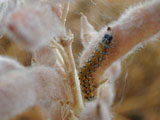
We found the picture to which you were referring in our database (see below). However, it looks as though it is on a mature plant, with browning seed pods, so it may not be the same caterpillar. This page of pictures of the Genista brown moth caterpillar (Uresiphita reversalis) is from the TAMU Horticultural Gardens at Texas A&M University. From the same source, here is a page of Texas caterpillars, with 38 illustrations.
Further research indicated that this caterpillar targets legumes, including the bluebonnet. Another target of this caterpillar is the Sophora secundiflora (Texas mountain-laurel), again, a legume. Sometimes, it is referred to as the "Sophora worm" and we found a website under that name from the Maricopa (Arizona) County Cooperative Extension services. Our first choice in organic control of this caterpillar would be hand-picking and squishing it; excuse the technical term. The article we referred to includes treatment by BT (Bacillus thuringiensis), with instructions for its application. These instructions infer that Spring is the time when this caterpillar should be treated, so you will need to make your own decision on whether this critter is threatening your bluebonnets now.
From our Native Plant Image Gallery:
More Wildflowers Questions
Franciscans and bluebonnets
October 05, 2007 - I always thought the bluebonnets were native to Texas.
However, I'm reading a book on the Missions of Old Texas and the author
states the Franciscan brought into Texas the horse, cow, honey bees ...
view the full question and answer
Federal database on use of wildflowers
June 24, 2008 - Recently read about wedding planned to reduce typical costs AND "go green." One action the bridal party took was to decorate with wildflowers. I was appalled. So, my question, because apparently..my...
view the full question and answer
Will my wildflower seeds reseed by themselves?
February 11, 2010 - I have planted wildflowers from seed throughout the several acres of my property in the Hill Country near New Braunfels. Once estalished will they reseed without any help from me? The flowers includ...
view the full question and answer
Wildflowers blooming in upstate South Carolina from Seneca SC
April 13, 2011 - When do most wildflowers bloom in upstate South Carolina?
view the full question and answer
Planters for wildflower exhibit in Jemez Springs NM
November 28, 2010 - I am planning to have a wildflower/pollinator exhibit at a visitor center located on a high elevation grassland (no trees). I would like advice on the size of the planter boxes.The area is located at...
view the full question and answer
| Support the Wildflower Center by Donating Online or Becoming a Member today. |