Native Plants

Q. Who is Mr. Smarty Plants?
A: There are those who suspect Wildflower Center volunteers are the culpable and capable culprits. Yet, others think staff members play some, albeit small, role. You can torture us with your plant questions, but we will never reveal the Green Guru's secret identity.
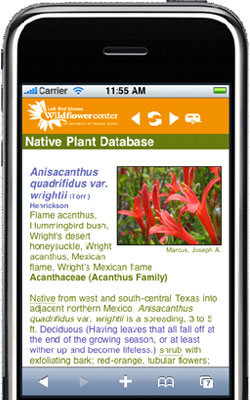
Did you know you can access the Native Plant Information Network with your web-enabled smartphone?
Ask Mr. Smarty Plants
Ask Mr. Smarty Plants is a free service provided by the staff and volunteers at the Lady Bird Johnson Wildflower Center.

rate this answer

Tuesday - December 29, 2009
From: Sarnia, ON
Region: Canada
Topic: Vines
Title: Pruning Bittersweet Vine
Answered by: Anne Bossart
QUESTION:
I am interested in learning how to prune my American bittersweet. The vine has enjoyed it's second summer in my backyard. I would like learn how to prune it, not only for size, but to help keep the vine healthy and strong. Last spring I pruned it, but think that it must have been too late as I had no flowers. I have access to a stock of 'wild' American bittersweet and would like to start propagating and planting more in the wild. As a child I remember it growing in many areas, but that has all but disappeared. Hints on propagation would be appreciated. I live in Sarnia which is located in southwestern Ontario, Canada. And, is there a way to identify male and female plants before seeing the blooms?ANSWER:
First you need to determine whether you are, in fact, dealing with our native Celastrus scandens (American bittersweet) or the invasive Oriental bittersweet which is rapidly overtaking and eliminating the native version in the wild.
There are two easily identifiable differences between the native and oriental vines. The native vine has smooth stems and bears its flowers (and berries) terminally (that is at the end of the stem only). The oriental version has thorns on its stem and bears its flowers (and berries) along the length of the stem at the leaf axes. You will find the photos and descriptions on the Evergreen Database very helpful. This article on About.com is also informative. The fact that you pruned it and it did not flower is encouraging; it likely means that your vine is the native species.
So ... going on the assumption that the plant you acquired is the native variety, when and how you prune it is quite critical to it blooming and bearing fruit. Generally, vines are only pruned to keep them from gaining the upper hand on whatever is supporting them. They also take several years to establish; "the first year they sleep, the second year they creep and the third year they leap" is a saying I heard from a more experienced gardener when I was younger (probably wondering why I only had only one bloom on a clematis I had planted that spring). Vines that flower on new wood (this year's growth) should be pruned in late winter or early spring before the plant sets flower buds. The Brooklyn Botanical Garden article about pruning vines goes into more detail. Remember that the flowers are produced on the ends of the stems so prune the plant so there is lots of new growth.
Unless the plants are flowering, you will not be able to differentiate between the males and females. The flowers on the female are not that impressive, and are barely noticeable on the male.
The bittersweet vine can be propagated by sowing seed or taking cuttings. Remember that if you take cuttings, the new plant will be genetically identical to the parent (i.e. male or female) but if you sow seed it will be an new individual.
Propagation instructions according to our Native Plant Information Network are as follows:
Sow seeds in fall or stratify and sow in spring. Bittersweet can also be propagated by root cuttings, layers, suckers, hardwood and softwood cuttings. Treatment of cuttings is not necessary, but it may hasten rooting.
Seed Collection: Collect seeds as soon as the capsules separate and expose arils. Spread fruit in shallow layers and allow to air dry for 2-3 weeks. Remove seeds by flailing or rubbing on a screen. Allow to dry another week. Store dried seed in sealed containers at 34-38 degrees (F).
Seed Treatment: Stratify for 2-6 months at 41 degrees (F).

More Vines Questions
Identification of bush/vine with purple berries
August 09, 2014 - I was clearing fence line and came across this plant it looks like a Bush but underneath grows like a vine it has long broad leaves that reminded me of Polk salad but it grows berry clusters the berri...
view the full question and answer
Difference between invasive Chinese and Japanese wisterias and native wisteria
September 12, 2014 - Dear Mr or Ms Smarty Plants,
Is there any way I can tell for sure if my wisteria is native? I bought it at a place when it was in bloom that sold a lot of native plants. I Would like to know for sure...
view the full question and answer
Identification of vine with 4-petaled purple flower
May 30, 2012 - Does anybody know what vine has a purple four petaled flower with small bulb in middle??
view the full question and answer
Need a vine to cover a chainlink fence in the shade in Tarrytown, NY.
June 08, 2012 - Any advice for a vine to cover a chain link fence in shade
view the full question and answer
Identification of a vine with 3 leaves and a red trunk
January 02, 2014 - What is a vine with 3 leaves that has a red trunk?
view the full question and answer
| Support the Wildflower Center by Donating Online or Becoming a Member today. |