Native Plants

Q. Who is Mr. Smarty Plants?
A: There are those who suspect Wildflower Center volunteers are the culpable and capable culprits. Yet, others think staff members play some, albeit small, role. You can torture us with your plant questions, but we will never reveal the Green Guru's secret identity.
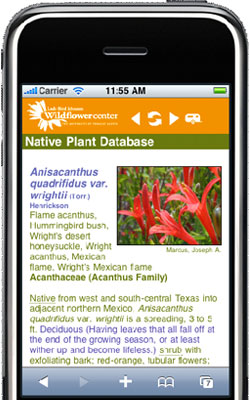
Did you know you can access the Native Plant Information Network with your web-enabled smartphone?

Ask Mr. Smarty Plants
Ask Mr. Smarty Plants is a free service provided by the staff and volunteers at the Lady Bird Johnson Wildflower Center.

rate this answer

Monday - January 04, 2010
From: Austin, TX
Region: Southwest
Topic: Poisonous Plants
Title: Need information about the toxicity of some newly acquired plants in Austin, TX
Answered by: Jimmy Mills
QUESTION:
Hi Mr. Smarty Plants, I just got a Carolina Buckthorn tree, a silk tassel, a wafer ash, and an escarpment black cherry tree. I wonder if any of these trees produce berries that would be poisonous to my grandchildren or my dog???? Thank you so much. I'm enjoying reading your questions and answers!ANSWER:
When Mr. Smarty Plants gets inquiries about toxic plants, there are several databases that he consults, and I am going to share them with you for future reference.
I have perused the lists below looking for the trees that you planted; Carolina Buckthorn Frangula caroliniana (Carolina buckthorn) , silk tassel tree Garrya ovata (eggleaf silktassel) , wafer ash tree Ptelea trifoliata (common hoptree), and the escarpment cherry Prunus serotina var. eximia (black cherry).
The silk tassel tree and the wafer ash were not on any of the lists, however the escarpment cherry was on all of the lists, and the Carolina Buckthorn was on two.
Members of the genus Prunus are well known for being toxic. The toxic compounds are cyanogenic glycosides that are found in leaves and the seeds. (more information)
The Buckthorn is sometimes placed in the genus Rhamnus, and this genus is listed is the one found in the databases. The toxic compounds are glycosides that are found in the berries. (more information)
Poisonous Plants of North Carolina http://www.ces.ncsu.edu/depts/hort/consumer/poison/poison.htm
Cornell University Plants Poisonous to Livestock http://www.ansci.cornell.edu/plants/
Toxic Plants of Texas http://essmextension.tamu.edu/plants/toxics/
University of Pennsylvania Poisonous Plants http://cal.vet.upenn.edu/projects/poison/index.html
Canadian Poisonous Plants Information System http://www.cbif.gc.ca/pls/pp/poison?p_x=px
University of California at Davis http://www.plantsciences.ucdavis.edu/ce/king/PoisPlant/Tox-COM.htm
More Poisonous Plants Questions
Is Norfolk pine poisonous to cats?
December 11, 2009 - Is a northfork pine poisonous to cats?
view the full question and answer
Comment on poisonous sweet pea plant from Kalama WA
October 29, 2011 - No question, comment only. I am aware of the story of Christopher McCandless (Call of the Wild)and the belief that he was poisoned by ingesting part of the sweet pea plant; however I am curious what ...
view the full question and answer
Major poisonous plants in California
June 26, 2013 - Hi!
So I'm working on an art project that requires a comprehensive list of poisonous plants within California. I'm looking specifically however, for plants which are fatally poisonous (upon inges...
view the full question and answer
Propagation of Mountain Laurel by seed
April 20, 2006 - I have a Texas Mountain Laurel. I found on this website that the beans are poisonous, but if you plant them, will they grow another Mountain Laurel?
view the full question and answer
Is Desert willow poisonous to horses in Boerne TX
July 17, 2009 - I have just purchased Bubba Desert Willows and have horses. Will they eat them, do you know and if so will they be harmed? Thanks
view the full question and answer
| Support the Wildflower Center by Donating Online or Becoming a Member today. |