Native Plants

Q. Who is Mr. Smarty Plants?
A: There are those who suspect Wildflower Center volunteers are the culpable and capable culprits. Yet, others think staff members play some, albeit small, role. You can torture us with your plant questions, but we will never reveal the Green Guru's secret identity.

Did you know you can access the Native Plant Information Network with your web-enabled smartphone?

Ask Mr. Smarty Plants
Ask Mr. Smarty Plants is a free service provided by the staff and volunteers at the Lady Bird Johnson Wildflower Center.

rate this answer

Monday - November 09, 2009
From: Rock Island, IL
Region: Midwest
Topic: Poisonous Plants, Herbs/Forbs
Title: Fall care for Fan Scarlet lobelia in Rock Island IL
Answered by: Barbara Medford
QUESTION:
What do I do with Scarlet Fan lobelia in the fall; do I cut it back or let it go as is?ANSWER:
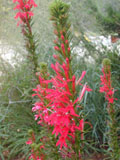
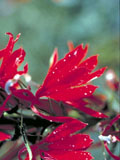
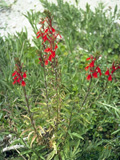
This is apparently one of those occasions when a plant retailer felt that the regular name for a plant wasn't exciting enough to be a good seller. When we searched on "lobelia" in our Native Plant Database, we found 17 members of the genus Lobelia native to North America and 8 of them native to Illinois, but none had the common name 'Scarlet Fan." So, we searched on the Internet for that name and found this Greenhouse Product News Lobelia cardinalis 'Fan Scarlet'. It turns out that it is Lobelia cardinalis (cardinalflower), a very nice herbaceous blooming plant native to Illinois.
So, back to our Native Plant Database, we found these Growing Conditions for the plant:
"Water Use: Low
Light Requirement: Sun , Part Shade , Shade
Soil Moisture: Wet , Moist
CaCO3 Tolerance: Medium
Soil Description: Moist to wet, humus-rich soil. Medium Loam, Clay Loam, Limestone-based, Sandy, Sandy Loam, Clay
Conditions Comments: Cardinal flower has very showy red blooms. It is particularly attractive at the edge of a woodland garden. The soil must be kept moist or wet at all times. A winter mulching in northern climes is beneficial. It can be propagated by bending a stem down into the mud and fastening it with a rock or sticks."
Since it is a perennial, we would recommend cutting it back to about 6 inches from the ground, marking the place where your new plants will emerge from the roots in the Spring. This should help you identify your plant so you don't think those little green leaves coming up are weeds and yank them out. Also, notice that mulch is recommended in northern areas, which we would consider Illinois to be.
One other thing from our Database we felt we should mention is:
"Warning: POISONOUS PARTS: All parts. Toxic only if eaten in large quantities. Symptoms include nausea, vomiting, diarrhea, salivation, exhaustion and weakness, dilation of pupils, convulsions, and coma. Toxic Principle: Alkaloids lobelamine, lobeline, and others, plus a volatile oil. (Poisonous Plants of N.C.)"
From our Native Plant Image Gallery:

More Herbs/Forbs Questions
Need suggestions for material to build a raised bed garden
February 13, 2015 - I am starting a raised bed garden but cannot find untreated railroad ties or landscape timbers. Does anyone have a source in the Austin or Dripping Springs area? I have tried McCoys, Home Depot, Natur...
view the full question and answer
Fertilizer amounts for native perennials in Belton, TX
March 18, 2009 - I am a novice gardener and need advice on how to fertilize my native perennials. I would like to use organic fertilizer and need advice on exactly what to use. I have a compost pile but it does not ...
view the full question and answer
Low-maintenance native plants for Arizona
March 12, 2009 - Will you please suggest some Native plants that can be left without care for the summer and survive - other than cactus?
view the full question and answer
Low maintenance, low growing native plants
August 21, 2007 - Mr. Smarty Plants,
Could you recommend several low growing easy to maintain plants for planting next to our house. The area for the plants is next to the house(white stone) in between the house and t...
view the full question and answer
Growing Texas wildflowers indoors for a March wedding from Austin
October 01, 2013 - I have learned so much from this site! Thank you! I am getting Married this March and I am hoping to use Texas wildflowers for the centerpieces. I hope to grow them in containers indoors and have the ...
view the full question and answer
| Support the Wildflower Center by Donating Online or Becoming a Member today. |