Native Plants
Q. Who is Mr. Smarty Plants?
A: There are those who suspect Wildflower Center volunteers are the culpable and capable culprits. Yet, others think staff members play some, albeit small, role. You can torture us with your plant questions, but we will never reveal the Green Guru's secret identity.
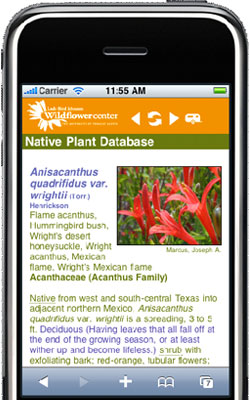
Did you know you can access the Native Plant Information Network with your web-enabled smartphone?

Ask Mr. Smarty Plants
Ask Mr. Smarty Plants is a free service provided by the staff and volunteers at the Lady Bird Johnson Wildflower Center.

rate this answer

Tuesday - October 27, 2009
From: Monroe, LA
Region: Southeast
Topic: Non-Natives
Title: Care for non-native Mexican ruellia in Monroe LA
Answered by: Barbara Medford
QUESTION:
Dwarf Mexican Petunia I have found information that late in the season, when growth becomes leggy, cut back plants by as much as a half to force a new spurt of growth. Watch for tobacco bud worms, aphids, snails, and slugs. What is the most effective plan for controlling the above problems? I have grow beds and all my potted plants both in the hoophouses and out in the open are on black ground cover secured with six inch staples.ANSWER:
You are really dedicated to those ruellia; we believe we just answered a question from you about holes in the leaves of your ruellia. They are, as we mentioned to you in our last answer, still not native to North America, and therefore out of our range of expertise.
In fact, the holes in the leaves that you asked about last time may very well have been caused by slugs or snails, the bane of any plant that is in moist soil and shading the ground for the beasties to hide. From The Garden Helper, we found this information on Controlling Snails and Slugs in Your Garden.
Apparently the tobacco budworm is quite a pest of geraniums and petunias, and this University of Florida Entomology Dept. website on Tobacco Webworm has some suggestions, but no guarantees, on control.
Aphids are really pretty easy to control-a good squirt of water or, if you are really serious, a good squirt of soapy water, will wash them off and they can't get back onto the plant. This University of California Integrated Pest Management website discusses the control of aphids in more detail.
As for trimming your plants back in the Fall; this is always a good idea with perennials. We like to leave about 6 inches of the stalk so we will know where they will begin to emerge in the Spring and not accidentally mistake them for weeds and yank them out.
More Non-Natives Questions
Problems with non-native corkscrew willow in Homerville GA
May 25, 2009 - I have a corkscrew willow tree and it the branches are turning dark and dying. What could be the problem?
view the full question and answer
Illegal to remove an orange blossom from ground in Florida from Atlantis FL
March 28, 2012 - Is there any law that prevents someone from removing an orange blossom from the ground in Florida?
view the full question and answer
Need some help with a Plumbago plant in Mission, TX.
August 06, 2010 - Hello..I live in south South Texas and have a plumbago. It gets about 4 to 5 hours of direct sun and lately some of the branches and leaves turn bright green almost yellow. Am I over watering or is ...
view the full question and answer
Planting location of non-native Japanese maple in Toronto
May 22, 2009 - Hi Mr. Smarty,
I am in the region of Toronto, Canada. I just bought from nursery a "Red Select" Janpanese Maple, about 2' tall, still in its 1' pot. I intended to plant it in my front yard ...
view the full question and answer
Apache Pine for Dripping Springs, TX.
July 02, 2014 - Is the Apache Pine tree a good choice for planting in alkaline soil with excellent drainage?
view the full question and answer
| Support the Wildflower Center by Donating Online or Becoming a Member today. |